Sunday, May 13, 2007

Willy Wonka Hypocrisy

So I had the opportunity to rewatch this movie recently. The original Willy Wonka. A fine, fine film in my opinion. Has it aged well? Eh, mostly. It does feel out of place that Charlie bumps into an honest to God tinker outside the factory gates. I mean, a tinker? Even in 1971 I'm not sure how many tinkers there were wandering the streets.

Also there's the gum thing. I feel like I grew up in an era that was still recovering from some kind of childhood gum plague. Teachers in school would tell us with the harshest insistence: "Absolutely no gum chewing in my classroom! Do you hear me!" And we're all looking at each other thinking "Gum? Who chews gum? What gum?" So presumably there was a time when children chewing excessive amounts of gum was a huge problem, I just had the good fortune to be born afterwards. No, our problem were those damn curling bracelets that looked like little rulers but they snapped onto your wrist. What were those things? Where have they gone?

But anyways, Willy Wonka and the Chocolate Factory takes a bold stance against gum chewing, and it does feel a little out of date. But dated or not, it is still a great movie.

Well, except for a slightly bigger problem. See, the film has always seemed a little hypocritical to me. How? Well, the Roald Dahl book is a morality tale. Dahl shows us that kids with bad habits get what's coming to them. Take Augustus Gloop for instance:


He's a glutton. He's fat. He eats too much chocolate. He falls in the chocolate river and gets sucked up the pipe. Lesson: don't be such a pig. But now here's the funny thing. Do you know who made the film? Not Paramount or Disney. The film was made by the Quaker Oats Company, and it was made first and foremost as a marketing tool to sell these candy bars:


The actual Wonka candy bar was a complete failure (supposedly it was like a Nestle Crunch bar with graham instead of crackle), but the movie was a big hit. Now if you want to make a film adaptation of a Roald Dahl morality tale about the dangers of eating too much chocolate, do you really think it's wise to use the film as a vehicle to sell chocolate? Don't you think that just slightly undermines the message?

And that's without even mentioning that the book contains another character, Mike Teavee, who's addicted to television:


Why would you make a film adaptation out of a story whose moral is that television is bad for children? Isn't there a bit of a problem there? It would be like, I don't know, making a Cliffs Notes edition of a book about the dangers of using Cliffs Notes. Or taking a book about the sad lives of circus animals, and doing a stage adaptation of it with actual circus animals. It's just not a good idea. Did the filmmakers mind these two casual betrayals of the moral of the story?

So there's always been that hypocrisy with the Willy Wonka film. The film tries to draw moral lessons, and the filmmakers undercut the lessons. But then, with the new, inferior Tim Burton remake, we get a fresh dose of hypocrisy.

See, they've reinvented Mike Teavee. Now he's a video game addict. He's not just vain like the original Mike, now he's violent:


What a smart idea. How bold of Tim Burton to update Mike for the 21 century. It's not just television that rots the brain, it's these damned video games. Good for you Tim Burton! Kids today need to be told what's bad for them. What bold commentary. What fresh insight. What courageous... wait a minute! Hold on! What's this?


Why, it's a video game of Tim Burton's Charlie and the Chocolate Factory. "Hey kids, crack is bad for you. Oh and by the way, here, have some crack." Tim Burton, you're a hack. You're nothing. And yeah, the movie sucked. What the hell was up with Johnny Depp?

Do you see now why I hate marketing? Look how they've exploited Roald Dahl and undermined his story. Look how they've sold him out. And for what? To make money? Is that all? Man does this get me cheesed.

Saturday, May 05, 2007

Branding

I'm going to have to go into full soapbox mode for this one, so everyone should probably stand back. In fact you may just want to browse out of here.

I think that advertising cheapens and coarsens our lives. It pollutes society. It takes the joy out of everything it touches. It teaches us all the wrong lessons. Any one ad, taken in isolation, is irritating but benign. It's the cumulative force of tens of thousands of them, over years, that cause permanent damage.

Coca Cola, you see, doesn't make you happy. It doesn't mean that the party has started, it doesn't help you bond with the guys, it doesn't take you back to the old days. There are other things in life that really can make you happy; but if you've been tricked into thinking that Coca Cola does it, you're that much poorer. You're further away from the real pursuit of happiness. You've let Coca Cola detour you into a dead end.

I've tried to resist this programming. I know that ads promise things, like happiness, that have nothing to do with their product, but I don't think I've escaped the effects. I know I've been programmed to think that going out and buying something will make me feel better. The act of buying and the act of owning have been drilled into me as the source of personal fulfillment.

Just a brief disclaimer now. All of this is not a prelude to saying that we need to a) renounce materialism and go live on a commune, or b) find Jesus. I'm actually a big cheerleader for materialism, in the sense that I think that all of our material conveniences and comforts are necessary stage-setting for the real pursuit of personal fulfillment. My swiffer doesn't provide happiness, but it cuts the cleaning time in half so that I can spend that surplus time doing something meaningful (or, more typically, playing Grand Theft Auto). For that reason alone I'm grateful for the swiffer.

It's "branding" that has to go. Branding is evil. Branding is responsible for this cheapening of our lives. Here's my amateur theory on the subject.

I think in the old days of consumerism, the really old days, there was no government oversight, no money-back guarantee, snake oil salesmen selling you mysterious tonics and potions, and lots of bad science floating around. If you bought something, drank it, and were allergic to the wrong thing, you could keel over and die. This is why good products, back then, had to trade on their name. If your toothpaste said "Colgate" on it, then you could be relatively assured that it was good toothpaste.

I seem to remember as a kid that a lot of advertising would stress the word "guarantee". Our product is guaranteed. Works every time or your money back. Company founders would appear in their best suit in the ad and give their personal word that the product was guaranteed to work as promised. You don't see that too much anymore. No one makes "It really works!" the focus of the ad these days. Now it's more likely to be a 30 second skit with a joke and some sexual innuendo with the product as a central prop to the play.

The reason why the "guarantee" ads have disappeared is that everything is guaranteed now. By the time something gets to your supermarket shelf, it's passed every conceivable test for safety and effectiveness. And if something still manages to go wrong, you get immediate service recovery. And if something still isn't resolved to your satisfaction, you can sue the bastards.

But the whole reason that Brands and Jingles and Catch-Phrases existed was to convince you of the quality of the product. Now that the quality of any product on any shelf is always guaranteed, what do we need the aggressive sales pitch for anymore? I've always conceded that commercials can sometimes function in an instructive way - for example showing me a upcoming movie that I wasn't aware of, or alerting me to a going-out-of-business sale, or announcing hat day at the ballpark, etc. But there's no longer any need to tell me to use Colgate brand toothpaste.

Because, now, there's no difference between Colgate, Aquafresh and Crest. None. It's all the same thing. Any ad that tries to persuade you that Colgate is superior is just a phenomenal waste of time, money and energy. At best, it annoys you and spoils an otherwise pleasant 30 seconds. At worst it actually succeeds in persuading you that Colgate is better.

So how can a commercial persuade you that one branded commodity product is better than another branded commodity product. The method that marketers have discovered is to persuade you that the toothpaste offers something more than just the normal toothpaste-y goods. One way is to differentiate the brand by inventing lots of different toothpaste categories, like Tartar control, extra whitening, maximum strength (?), etc.

But the problem with that is that Aquafresh and Crest will quickly mimic any successful toothpaste differentiation you can cook up. They'll have their own Tartar control product. So now what?

Now is when you get really sneaky. Now is when you decide that toothpaste can actually transport you into an entirely different lifestyle or social class. If you make an ad that shows a woman scrubbing with Colgate before hopping gleefully into bed with an attractive man in what is obviously a well appointed house, you're pitching a lifestyle. If you see that commercial enough thousands of times, you might actually start to associate Colgate with great sex and fabulous wealth.

And yes, I'm by no means the first person to make this case. In fact it's been made to me in several classrooms - sadly though it's been made by teachers who actually endorse this kind of marketing, and who clearly admire the strategy.

Modern marketing says that you don't pitch the product, because that's futile - all of your competitors have the same product. You have to pitch something that's out of reach, something that's otherwise unobtainable. Colgate doesn't just clean your teeth, it also leads to great sex. You don't need to demonstrate how Colgate can provide great sex, you just need to put them in the same picture frame over and over.

Now this indeed might be the best way to boost toothpaste sales. I can't fault the theory on its successful track record. But I wonder if the professors and faculty in my school's Marketing Department have thought about what they're helping to do to society. (Jeez, and I really hate writing sentences like that last one. But it's worth it. The message has to get out.)

What it does is promote a gnawing sense of insecurity that whatever we currently have isn't good enough. This bombardment of film footage that we are constantly subjected to that equates product ownership with happiness - it messes with our programming. I know my programming has been permanently altered. If someone were to ask me right now: what's the best laundry detergent on the market? Without hesitation I would say "Tide". But, Tide isn't better than any other detergent. All of those detergents: Wisk, Gain, All, Cheer, Tide - all of them - they're all the same. That smug sense of satisfaction I get when I take my Tide to the laundry room and see all the poor saps with their generic supermarket detergent. How I pity them! They can't afford Tide. Maybe I should be charitable and give them a cup? Give them a taste of the good life... See how Tide has twisted my brain?

And these professors, these educators are going into the classroom every day and instructing the next generation how to perpetuate the deception. Does anyone ever raise their hand and ask why we should devote so much time and strategy to convince total strangers that Coke is better than Pepsi, when it's actually not better? That would be a fun question to ask in class.

What can I possibly hope for here? Will ads ever die? Sometimes, when the product becomes so commoditized that no one can even pretend to claim that their brand is better, then the ads go away. Like... I don't know - salt. No one makes ads trying to claim that their salt is the bomb. Unless I just haven't seen them. I can't recall any salt ads where the woman takes the salt down from the cupboard and the muscular, manly husband comes up behind her and puts his arms around her and nuzzles her neck. "Mmm... smells delicious honey. Is that Morton's Iodized table salt?"

Well, yep, I'm definitely plummeting down from the coffee high now, so it's time to wrap it up. People, don't be fooled by ads. All those different brands, they're all the same. Okay, maybe a laundry detergent connoisseur can detect the slightly different bouquet of Cheer and prefers it to Downy, but whose fault is it that he got the idea in his head to have a detergent preference in the first place? Can one really have a preference? Can one really express individuality through brand choice?

All right, I'm done. No more soapbox today.

Saturday, April 21, 2007

Ads for States


Isn't it true that there are certain businesses that just shouldn't advertise? Especially on TV? When you see a lawyer standing in front of a wall of books saying "Have you been injured in a motorcycle or automobile accident?" - doesn't that ad accomplish the exact opposite of what it intends? The only thing it tells me is: do not, under any circumstances, use this lawyer. A lawyer who advertises on TV cannot logically be a good lawyer. I'm not saying he's not a lawyer who can't make money from rolling the dice on car-accident cases, but still - he isn't a good lawyer.

And so it is with states who pump out the ads on TV. Here's the rule of thumb. The more feverish the state's tourism office seems in its advertising, the more it boasts, the more they deluge you with their ad campaign, etc. the less you'd ever want to go there.

How many times have you ever seen an ad that says: "New York. Excitement awaits!"
How about never? "The District of Columbia. Come see our rich history." Nope. "Texas. Saddle up and ride!" Haven't seen it. These places don't need ads. These are states that are confident in their ability to draw a crowd. They don't need to strut on the street corner that is a Jeopardy! commercial break.

By contrast, no matter where I go in the US, I am carpet bombed with ads for North Carolina. All the freaking time. The beaches. The surf. The lush landscapes. The history! The peaceful bucolic countryside. zzzzzzzzzzzzzzzzzzzzzzzzz

Every damn state has natural splendor. Even New Jersey and Delaware and Rhode Island and Kansas has its share of natural splendor. No matter where you are in the USA, you are probably no more than an hour's drive from as much natural splendor as ANYTHING North Carolina has to offer. What am I saying? I'm saying you can't make "Come see our natural splendor" the central focus of your state tourism ad campaign. A few states like Alaska can get away with it. But North Carolina is just barking up the wrong tree here.

With the NC ads I get this distinct whiff of the old orange juice ad problem. The orange juice ads would remind us how healthy orange juice is and then say something like "Doctors recommend drinking a glass of Tropicana orange juice every day." Well why does it have to be Tropicana, doctor? The same goes with North Carolina. "Like beaches? Like, uh, ferns? Like crickets at night? Like clement weather? Then come to North Carolina!" Well why? Why North Carolina? What temptations and delights can NC possibly have to distinguish it from whatever state you're already in? If what you want is a beach trip, aren't there a dozen states with better beaches? How about Civil War sites? Aren't there far better places to go? Lush countryside? Sleepy towns? What? Tell me! Why would I possibly set foot in this mediocre state?

I give North Carolina Kitty Hawk and that's it. I'm sure there's a good exhibit there, and then probably a decent crab shack next door. Fine. That's one interesting morning you can spend in NC. Other than that, there's no reason to visit. The info on the state quarter pretty much satisfies all my curiosity about NC.

Doctors

And doctors too, of course. Any doctor that advertises on TV is a doctor to avoid. In fact, there's really only one method to find a good doctor. What you do is mention to a trusted friend that you've got this recurring sinus infection, and then the friend leans over and tells you in a conspiratorial tone: "I have this great Ear Nose & Throat guy. The best. Give him a call. Tell him you're a friend."

Then you call the guy, and you find out that a) He doesn't take your piddling insurance plan, b) he doesn't take cash patients, and c) there's a 6 month wait for an appointment. That's how you find a good doctor. You don't just scan your PPO book for the guy with the closest office, and you certainly don't trust a doctor who advertises on TV.

Universities

And hoo boy, you do not want to go anywhere near a institution of higher learning that sees fit to market itself to a mass audience. I suppose if you're completely unskilled and unemployed, and you see an ad for some vocational technical school, then that's okay. Something like DeVry. But if it's an actual 4-year college or university with aspirations to seriousness and respectability, then what the hell are they thinking? When was the last time you ever saw "Harvard. A fine education... at reasonable prices."

There are just some places and people: doctors, lawyers, universities and states - whose success depends on a perceived self-confidence. By advertising, you cheapen yourself. You expose yourself as struggling in the contest with your competition. You send out the warning beacon to stay far away.

Now go on and sue me, states! That's right, take your best shot! (These state tourism offices can be litigious. Just see what the state of Maine did to a blogger who dared criticize its ad campaign)

Sunday, April 01, 2007

These "Unrated" DVDs of PG-13 Movies


Isn't this just the biggest crock?

I'm afraid I missed the long, slow buildup to what is currently an enormous cinematic debacle. Just as you don't see an ant or a roach until you've got a full blown infestation, it wasn't till recently that I scanned the aisle at Blockbuster and Hollywood Video and realized that every third title is "Unrated and Uncensored!"

Again, what an enormous, stinking load of bullshit this is. To add 2 seconds of bared breast to your unpleasant PG-13 comedy and then release it as Unrated! like it's a long lost cut of Behind the Green Door - it makes me want to give up all civilization and become Amish. Then kill a lot of people. And then become Amish again.

Here's a condensed version of this sad story. Once upon a time, back when ratings were a whole lot stricter, there were movies that were too violent/disturbing/sexual to get an R rating. But it was the kiss of death to accept an X rating, because the porn industry had eagerly claimed that letter as its own. So if you were unwilling to cut the film down to an R, you screened the movie where possible as "unrated" and hopefully made a few dollars. Unrated meant X, but not porn.

Then we got NC-17, which was supposed to eliminate the gray area, but it didn't work because theaters still wouldn't screen NC-17s and most stores wouldn't carry them. At this point, moviemakers essentially gave up, and resigned themselves to not making movies that couldn't pass by with an R. We, the public, are the losers. In a way, the pendulum has swung back towards permissiveness, since the R rating keeps getting more and more lenient. I'd say it now captures most of what was previously NC-17 territory. Can any movie get an NC-17 for violence alone? At one time I'd say yes. Now, no.

So that's the history of the "unrated" label that the American Pie marketers are now feverishly trying to exploit. Never mind that today's young audiences don't know that "unrated" used to mean taboo, the tactic seems to be working all the same. So now you've got one of these Mr & Mrs Smith or Date Movie! type movies, and they're barely squeaking by with a PG-13. The studio strategy is to edit a blatantly R version of the film for the MPAA and ask for a PG-13 rating. The MPAA falls for the ruse perfectly by demanding a list of 15 specific cuts and changes to get the PG-13. But the studio doesn't care. They threw 40 things in there which deliberately challenge the PG-13 rating. If they have to remove 15, that means they get to keep the other 25. And they get the PG-13 rating.

So now, when it's time to release the DVD, you put the 15 cuts back in and you simply don't resubmit the new edit to the MPAA. Now you've got an unrated version. But here's the thing: The "uncensored" parts that you're now reincorporating into the movie were conceived as bits that could possibly slip by the MPAA into a PG-13 version. In other words, they're weak-R. They're barely-R. They were filmed with the intention of being part of a PG-13 movie.

So when you see something like this in the comedy aisle, stop and take stock of all the ways you're being insulted and deceived.

1) Nothing in America is censored. A DVD that claims to be uncensored is really just saying "We, the studio, chose to self-censor this movie earlier because we knew we could make more money. Now, we can un-censor our own product, because, again, we can make more money."

2) The bits that are now uncensored are weak, weak R-rated shots, some no longer than a single second. Go rent Fast Times at Ridgemont High. Even a tame R rated movie like that has acres more nudity than an uncensored Taj. Go rent The Sure Thing.

3) An attempt is being made to confuse you into associating an unrated PG-13 movie with the Unrated movies of yore. The real unrated movies. Doesn't that piss you off?

4) And what the hell is Blockbuster and Walmart and Target and Best Buy doing? Don't they have these high and mighty policies about only stocking movies with certain ratings? So now anyone can sell an unrated movie at Best Buy? What happens when Henry, Portrait of a Serial Killer comes out as unrated on DVD? What will the Best Buy policy be then? Or Delicatessen?
What kind of cartwheels of logic will be necessary to ban some unrated movies but keep others?

On my recent trip to Blockbuster I asked about their ratings enforcement. Do they treat their unrated movies as R's or PG-13s? Or more than R's? Answer: a blank stare. Kids can rent R rated movies at blockbuster if the account says that they have permission. Do the unrated movies count as R's? Apparently it's at the discretion of the guy at the counter. So..... no.

But don't get me wrong. What's bothering me isn't the idea of kid seeing a tit. It's the rank hypocrisy of Blockbuster. The pious rental chain that won't stock NC-17 fare, the chain that strictly enforces the rating system. I guess when you dangle an extra $3.25 in front of blockbuster their principled position kinds of melts away. And you know, it's not just the hypocrisy. And it's not just the studio's presumption of my stupidity. And it's not just the way that they market their movies to confuse and deceive.

Unrated movies used to mean something. An unrated video meant that you were about to see some seriously messed up shit, or at the very least some bush. Movies that could shock and appall. Exciting movies. Dangerous movies. Movies where buttery fingers could at any minute slip up Marlon Brando's anus and it was par for the course.

And now every third movie on the aisle is unrated, and so of course it ceases to mean anything. Pornographers, in the 70s, exploited the ratings process and turned it into a form of advertising. Single X.... how about Triple X! (question, was there ever a Double X porn movie?) Now, national lampoon is doing THE EXACT SAME THING. Using the MPAA process (and the MPAA are themselves spineless and unprincipled) as a way to promote product.

Roger Ebert is right. (Not something I say every day) The rating system is broken. The whole idea of going back and forth with the MPAA to get the most graphic and explicit R or PG-13 that you can goes against the entire spirit of what the ratings are for in the first place. It also guarantees that the limit of what's acceptable will just keep moving north. Ebert wants an "M" rating, for movies that are too harsh for R, but aren't pornographic. But he's misguided in thinking that this would work. NC-17 was the M rating. That was supposed to be its function. But it failed because it's never going to be in a theater's interest to take a film that comes with a built-in limited-audience handicap. The theater will always be better off posturing and saying "We only play family fare here", (as they show Hostel on 3 screens).

No, there really is no good solution. Eventually the establishment will take a stand against the proliferation of these unrated DVDs, and then blockbuster will clean up its act. Until then, sit back and enjoy borderline R movies that boast that they're Uncensored!

Porn in my PS2

Speaking of arbitrary ratings and smut, why is it that when I put porn DVDs in my PS2 I get prompted to authorize parental control level 8? What in God's name do I need to put in there to get prompted for level 9 or 10? Cause the scale on the screen goes to 10. You may not be aware how disheartening it is to put in some serious porn and find out that you've triggered only this medium-high response from the PS2 parental control. Here I thought I was going to watch some hardcore shit, and the PS2 is treating it like it's one of the lesser Emmanuelles, or a Victoria Secret catalogue or a Oui Magazine.

What do I have to do to get the 10, Sony? What do you want? A snuff film? Nazi medical experiments? I'll do it! Just tell me! I want that 10.

The scary thing here is that according to Sony's logic, they have envisioned a situation where a parent might permit a child to watch anything up to and including hardcore porn, but absolutely nothing more adult than that! You hear me buster! Level 8 and that's it! Now be a good boy and watch your Seka.

Saturday, March 24, 2007

Fill Soda Bottles Up All the Way, You Cheap Bastards


I mean wtf? As usual, I'm the one who has to give voice to what I'm sure is an unspoken, private complaint of millions. My whole life I've looked at that empty neck in the coke bottle, and my passing thought has always been: "Hmmm, I'm sure there's some good reason for that." But no, there is no good reason. The bottlers are cheap bastards, and they'll keep giving us progressively emptier and emptier bottles until we just refuse to take it anymore.

Have you ever thought about how much money you've spent on ATM fees over your whole life? A lot, right? Wouldn't it be nice to have all that money back? Well imagine how much soda you've lost to this 90%-full bottle bullshit over the years? Imagine a truck pulling up to your house with all that missing soda. You'd be sitting pretty, friends. You'd be set.

What are the purported reasons for the empty neck? So the soda can breathe, like a fine wine? So a freshly opened bottle won't spill as easily?

"Well come on Rowsdower, it's a carbonated beverage. It's physics. It's about the pressure building up in the bottle, especially when agitated. Don't complain about things you know nothing about."

Oh yes, of course! The carbonation. Wouldn't want to fill up a soda bottle all the way with all that pressure building up. I take it all bac... wha? Wait a minute.... what's this?

The same shit with bottled water? But I thought it was all about carbonation? Ahhhh, so that was just a pile of BS? I see. You cheap, cheap bastards.

Wouldn't it be nice to open a bottle of soda and see the fizzy, quivering surface right there at the top? To know you've gotten your full $1.25's worth? Look at Gatorade, people. See the way it should be done.


Now as long as we're talking about bottled water, I want to spend just a minute discussing some of the claims made on the water bottles about their purification process.

I always like to look, first of all, at where the bottle is maintaining the water comes from. And for the record, I trust something like "Bottled from an Idaho Municipal Water Source" about ten times as much as I trust something like "Bottled from the finest protected natural streams in the United States and Canada". Sometimes it's just "Bottled in Roanoke, Virginia" which tells you virtually nothing, although you can pretty easily assume it means somebody's tap. But my general rule of thumb is to trust the water that proudly claims that it's from a municipal source, and not to trust the bottles that get all vague about crystal streams and leafy glades and babbling brooks and sylvan glens. There's something ugly in that sylvan glen. Something they don't want you to know about. I steer clear of those waters.

But the latest trend is for the water to admit that it's bottled locally from the tap, but then to claim that all kind of purification rituals are performed on it, returning it to a pristine H2O state. I am deeply suspicious of this.

To understand my suspicions you need to understand the sorry state of Las Vegas tap water. For those of you who don't live here I'll break it down. We are serviced by the artificial reservoir Lake Mead - water diverted from the Colorado river. This wide open pool of standing water is pumped into our homes, and when the water is pumped out as sewage.... it gets a sewage treatment plant once-over..... and is dumped back into Lake Mead. Now recycling sewage back into drinking water might be okay on the international space station, but this is America's fastest growing city. If you actually drive out to lake Mead to look at our drinking supply, it's an alarming sight. People bathe in it. There are watersports. Jet skis zip around. Blue smoke pours out of outboard motors. Makes you thirsty, doesn't it?

By the time this reclaimed sewage has had the jet ski treatment and is pumped back into our homes it's been generously dosed with foul-tasting chemicals to make it safe for drinking. Which is a long way of saying that Las Vegas tap water sucks. It tastes like a children's pool.

So along comes a bottler like Niagara, claiming that they've purified our tap water. Suuuuuure.
The bottle says that they treat the water with:
1. Carbon Filtration
2. Reverse Osmosis
3. Microfiltration
4. UV Treatment
5. Ozonation

A list like this sets off all my warning bells. A name like "Reverse Osmosis" sounds too technical. It sounds like a name designed to pacify you into thinking that it's some really robust purification technique, when it fact all it means is that they've hired a person to blow on the water. If reverse osmosis means "blowing on water to make it colder" I am not going to be surprised. Okay, let's look it up....

Here's the scoop. Reverse Osmosis means "filtering". It's a screen that you push the water through. The water goes through, solid particles don't. Ah. How does that differ from... microfiltration? It doesn't. From wikipedia: "Microfiltration is not fundamentally different from reverse osmosis"

Ozonation and carbon filtering involve introducing carbon and ozone to the water to soak up bad things like bacteria. I have nothing to say about this.

Niagara water does taste pretty good, so maybe I shouldn't complain. But I can't shake the suspicion that purified Las Vegas tap water can't be much better than Kevin Costner's purified urine that he made on his Waterworld trimaran. The whole enterprise just seems wrong. I'll stick with my Idaho municipal water, if it's all the same to everyone.

Saturday, March 17, 2007

Gas Station American Flags

And now, let's talk about flags at gas stations. Huge, ginormous American Flags. Really big flags. Flags so large you need powerful, gale force winds to actually see them stream. The new home of the enormous American flag has become, for whatever reason, the suburban gas station. The Alamo never had flags this big. Tranquility Base on the moon didn't have a flag this big. Even George C. Scott would say, "Damn, that's one big gas station flag."


I have no problem with enormous gas station American flags; in fact they're nice to see. Plus, they sometimes offer urgent news bulletins. When Ronald Reagan died, how I did I find out? Word of mouth? A TV interruption? Nope, it was a gigantic gas station American flag, flying at half mast, alerting all that something was amiss. It's too bad we have to rely on something like a Chevron to uphold our civic traditions, but there you have it.

But friends, all is not well in the suburban gas station community. Was I the only one that noticed that the death of Gerald Ford threw them all into confusion? Did anyone notice (in whatever part of America you live in) that no one seemed to know when to return the flag to full staff? Ford died the morning of December 26th, and the flag is lowered for 30 days for the death of a president. But no one seemed quite sure when the 30 days were up. Was it 30 days to the minute of the death? 30 days from the presidential order to lower the flag? Or one month from the day of death? (Real answer: the flag could return to full staff after sundown on the 25th)

On the 25th, some flags were back up. Others stayed at half staff for days too long. My feeling is, if you're going to fly the largest American flags on earth as part of some who's-more-patriotic gas station arms race, you at least owe it to the people to obey the rules.

So my question is: who at Shell or Mobil headquarters is in charge of sending out flag bulletins? Does Exxon have a "Director of Enormous-Flag Affairs"? Does AM/PM have a Dead President Flag Coordination department? Does the slurpee guy actually do the raising and lowering? Does he fold a retired flag into the proper triangle.

I visited a local Terribles gas station (it's a Nevada chain) to get the answers. The clerk blinked a few times and referred me to the manager. The manager, for her part, seemed deeply suspicious that someone was asking about the flag. That particular flag is this one, although the picture doesn't really do justice to its size.


"We got a crew that takes care of that." she said. A crew?

"They do all the Terribles."

I wanted to know the name of the company, but I couldn't get any more information from the suspicious manager. Maybe if I get the chance I'll do a little more digging. For now though, lets just be thankful that we get to see businesses flying flags at all, even if it is just a transparent marketing ploy to try to erase the old public perception that gas stations are run by foreigners, and to somehow tie gas-buying with a feeling of patriotism. Despite all that, a giant flag is a welcome addition to our neighborhood skyline. Just learn the rules for raising and lowering it. That's all.


Celebrity Chefs

Continuing on, since I haven't posted in a while, I'd like to blow the whistle on the wild abuse of the term Celebrity Chef. You can't just go around claiming that your restaurant features a Celebrity Chef. You see, without any kind of controlling, regulatory body to assign people official Celebrity Chef status, just about anyone can claim to be a CC, based on nothing more than publishing a cookbook or making one or two TV appearances. That's a load of crap.

Emeril is a Celebrity Chef. Julia Childs was a Celebrity Chef. Paul Prudhomme. Maybe Wolfgang Puck. That's it. Chefs that manage to cross that boundary into the public consciousness. Everyone knows Emeril. BAM! But come on - being on the Food Netowrk a couple of times doesn't qualify you. It's the Food Network. It's a niche channel with a niche audience buried among hundreds of little cable channels. And being generally well known or well respected within the insular chef community - someone like Joel Robuchon - that doesn't cut it either. Publishing some books? Nope. Having a mildly well known restaurant that bears your name? Nope. That's a rich and successful chef, not a celebrity.

David Hasselhoff is a celebrity. Bobby Flay is not. Ohhhh, poor Bobby Flay. Go make me a steak, chef. That's right, put on a ridiculous hat and make my dinner. You're a food cooker. You prepare meals so that others can spend that time on other, more important matters. Oh, you're going to make some little artistic design with the onions on top? You're going to swirl the raspberry sauce around the cheesecake in some wild, crazy way? Oh yeah, that's art. You're a real celebrity. Please.


These Footnotes in the "Barnes & Nobles Classics" Books.

This requires a little explanation. Barnes and Noble publishes a series of "Classic" books - basically the more accessible classics like Huck Finn and Dracula - for reduced prices. It's a good deal all around: they've got relatively attractive covers, some new interviews or commentary, and you can't argue with the price. And if the goal is to introduce a new generation to the joy of great literature through some of the more readable books, who can object?

Well I do, damnit!

I was browsing through B&N, and when I saw the complete Sherlock Holmes in the Classics series for only $14.95, I couldn't pass it up. I love Holmes stories, and I had never read the novels. So I get home with these two fat volumes, I put on a pot of English breakfast, I get a crackling fire going in the hearth, and I settle in to read some Holmes. (all true except for the tea and the fire)

The first story, A Study in Scarlet, is a thrilling mystery with all of the anti-Mormon prejudice that you could possibly want. (and I like a lot) But on almost every page... there is a footnote. A big ol' asterisk with a note from the editor down at the bottom. Now, I didn't buy an annotated Sherlock Holmes, I wouldn't have wanted to. But according to Barnes and Nobles, these footnotes are simply:

"Designed to inform, and never to intrude. The elegant superscripts are clearly visible within the text, and the corresponding notes appear on the foot of the page for ease of reference. With a glance, footnotes briefly identify historical figures, gloss obsolete terms, and translate foreign words and phrases."

Yeah, except, these are the most asinine and unnecessary footnotes I've ever seen. How retarded does Barnes and Nobles Classics think its readers are? Check some of these out:

Sentence in the text: "With hardly a word spoken, but with a kindly eye, he waved me to an armchair, threw across his case of cigars, and indicated a spirit case* in the corner."

*Locked stand in which decanters of liquor and wine are displayed

Really? Wow, thanks Barnes & Nobles! Thanks for the interruption!

"There was a parallel instance in Aberdeen some years back, and something on very much the same lines at Munich the year after the Franco-Prussian war*."

*Conflict between France and Prussia, from 1870 through early 1871.

Ohhhhhhhhh, so it was a waaaaaar between France and Prussia! I thought it was a Franco-Prussian dance, or maybe a Franco-Prussian soup.

"I was standing at the Criterion Bar, when someone tapped me on the shoulder, and turning round I recognized young Stamford, who had been a dresser* under me at Bart's."

*Medical assistant whose duties include bandaging, or "dressing," wounds.

I still don't understand. You mean someone who puts on the band-aid?

Some other terms that are helpfully footnoted:
Farthing
Guinea
Half-Crown
Underground
Gaiters
Huguenot
Plantagenet
Consumption

And, worst of all, every single literary allusion or reference is footnoted. Every time Holmes tosses out a phrase from the bible, or Shakespeare, or any other great work of literature we get the asterisk. Imagine for a moment how annoying that is. When Holmes says "There is nothing new under the sun." do you, the reader, really need to know at that moment what verse of the bible that's from? Does every French word require a translation? Isn't part of the richness of the reading experience either a) catching these allusions naturally and letting them sweep you further into the story or b) knowing you didn't understand something and following up on it later on your own time? I don't know what's worse: being spoon fed like this, or having your ignorance presumed on what the London Underground is.

Go away, footnotes! Stop adding value to my purchase!

Wednesday, February 07, 2007

180 Annoyances

161. Movies where characters demonstrate how masculine and tough they are by taking a Tylenol and just swallowing it without water. Does anyone, in real life, choose to just swallow pills dry when water is easily available?

162. Old people in the theater who sit there and stare at the end credits.

163. That metallic-pumpkin car color.

164. Gym machines that really highball the burned-calorie estimate.

165. When you get a call from your power company or your cell phone provider or whoever, and they stay completely silent until you've said hello a second time.

166. Parents who have their baby's totally awesome sixth finger removed.

167. Using "I can't hear you!!!" more than once when pumping up the crowd.

168. That hairstyle you sometimes see with black women where it looks like their hair is painted on their scalp. I don't know what it's called but it's really off-putting.

169. Law firms with 6 or more people in the name. (For example)

170. Dressing up as a tennis pro for Halloween. Wearing a white shirt and shorts, carrying a racket, and draping a sweater over your shoulders is officially the least effort you could possibly make at a costume.

171. January gym crowding.

172. All those 10-10-220 and 10-10-321 commercials from about 5 years ago.

173. Sitting next to your parents during a movie sex scene.

174. The headache you get from an autostereogram.

175. How the Chinese government "owns" the panda species.

176. When the ambulence/firetruck eats your whole green turn arrow.

177. Being bent over a barrel by these frickin expensive cell phone plans. $100 a month? Didn’t phone ownership used to cost about $20 a month? Enjoy it while you can, Verizon, I predict it won’t last.

178. Pizza parlours that don't serve by the slice.

179. Coffee grounds in the last sip.

180. That one person at a dinner table toast who absolutely needs to clink every.... person's.......... glass.

Sunday, January 21, 2007

The Upcoming Presidential Campaign Season

With all of these politicians announcing their candidacy in the past week, we should all get mentally ready for the TWO YEARS of the 2008 presidential contest that pretty much has just started. And I'll be honest, I'm not looking forward to it. Why? Not because I'm politically apathetic or cynical about the process (actually, I guess I am cynical about the process), but because this is going to be like a two-year-long movie where I've already guessed the ending.

I'm going on record, right now, in January 2007. It will be Hillary, with Obama as VP, versus either Giuliani or McCain, probably Giuliani, and Hillary will win.

There, I said it. I almost feel bad saying it, like I'm spoiling the ending of the Sixth Sense or something. And lord knows, I'm not happy about that outcome. I'd much prefer Giuliani. But in my own mind, a Hillary presidency has been inevitable for some time now. The day she announced she was running for the Senate, back in what, 2000? - was the day I knew she'd be impossible to beat in a presidential contest.

But we're going to have to listen to two years worth of reporting on meaningless BS in the meantime. "Judy, tell us what kind of organization Bill Richardson is putting together. Where is he getting his braintrust?" And "Shep, I'm here in Mitt Romney's campaign headquarters, where it's fair to say they are VERY excited about the upcoming Iowa straw poll."

Why? Why? Do you have any idea how much airtime is about to be wasted on these candidates who have no chance? Now, a year or so back, I complained about the Vanity candidates. These were the guys like Al Sharpton and Alan Keyes and Gary Bauer who must surely have known that their candidacy was hopeless, yet they pressed on anyway with the intention of furthering a personal agenda that had nothing to do with becoming president. With Bauer, he wanted a platform for his nutty ideas. With Sharpton, he just wanted to feed his appetite for publicity and keep his personal profile high. Keyes I think just wanted a TV show.

This time around, with the new crop of hopeless candidates, I don't sense the vanity candidacy as much as I do the delusional candidacy, more in the tradition of Dennis Kucinich than Jesse Jackson. The delusional candidacy is when your candidacy is utterly hopeless, yet you're incapable of recognizing it. Take John Edwards for example. He's the guy who couldn't beat Kerry in the primary. And Kerry is the guy who couldn't beat the loathed, reviled, hated George W. Bush. Democrat primary voters have already formed this thought with regards to Edwards: "We had an unbelievable chance to take the presidency in 2004, cause Bush was so unpopular, and Kerry somehow managed to botch it. And we're supposed to vote for the guy who couldn't even beat Kerry?"

So Edwards has no chance. When Quayle mounted a candidacy in 1996 (or was it 2000?) that was also a delusional candidacy. Didn't he know that his Q score or whatever was in the toilet? Didn't he know he was a national laughingstock? Did no one tell him?

How about Mitt Romney? He's in the low single digits. He's Mormon. He won't be able to carry his own state. He's far to the right of everyone else. And yet my friends on the right are doing everything they can to build his buzz. Friends, the Romney candidacy is so utterly hopeless that I'd have a better chance of bluffing my way into the Mormons' big, exclusive Disney-esque temple for my own wedding than Romney does in capturing the white house.

Someone, please, give me a modern example of a guy who started out in the low single digits at this point in the campaign versus two powerhouses in the 30 digits each who somehow came back to win it. It just can't happen. And yes, the Mormonism is an issue. Don't be fooled by the spin. "We're just as Christian as anyone else." Nope. Uh-uh. "Worrying that Romney will take orders from Salt Lake City is just as foolish as worrying that John Kennedy would take orders from the Vatican." True. But that's not the issue. It's not that Romney might be taking orders from high-priest whoever, it's that he's stupid enough to actually believe in that unbelievable pile of horseshit called LDS. Why LDS is horseshit is beyond the scope of my little rant here, but I encourage you to do the most cursory research and find out for yourself.

Moving on to the two republican contenders. Giuliani and McCain. Here is where I feel least sure, but I give the edge to Giuliani for a couple of reasons. First McCain is old. If he's elected, he'll be older than Reagan was when he was sworn in. Second, McCain is a known quantity. There's nothing new or exciting about him. His signature issue still seems to be campaign finance refzzzzzzz....(snore)

Third, there's the Edwards problem. McCain is the guy who couldn't beat Bush in 2000. The hated, loathsome, reviled George W. Bush. Who's going to give McCain a shot now when his opponent this time (Hillary) will be much more formidable than Gore was back then? He couldn't beat Bush! On the Giuliani side of the equation, there's more to like. Sure he's not as conservative as many republicans would want, but primary voters are more savvy than that. They value electability. They will elect whichever republican has the best chance of beating Hillary. And that's Giuliani. Why? Here's my theory. Voters gravitate toward the candidate who best makes up for the specific shortcomings of the previous president. We have short memories. Bush was the anti-Clinton in 2000. He was a straight-talker, a straight shooter. He'd never betray his wife. Lying and being verbally slippery were against his nature. He promised to exercise moderance and temperance in his presidency. Now without getting into a debate about how Bush turned out, we can all agree that this was his persona in the 2000 campaign. He ran as the un-Clinton. The winner of the 2008 race will be the guy (or gal) who is the anti-Bush. This favors Giuliani. Giuliani projects raw, determined competence. He thinks. He acts. He takes no BS. He gets things done. He's smart. He motivates and can lead. He inspires. He's like the Joe Pesci of politicians. Whereas Bush is verbally clumsy, and articulates everything he says with that folksy smile and swagger that drives liberals insane, Giuliani has that no nonsense tone of voice. Giuliani's reputation, deserved or not, of competence and a record of results could propel him to the nomination. So at this point, I think he has the best chance.

Moving to the democrats, this one's a no brainer. I will start by observing that it appears that I am the only one in the universe who sees that Barak Obama is clearly running to become Hillary's VP, and not to become president himself. Just like I was the only one who was willing to say that Bill and Hillary's marriage was 100% about mutual political ambition, and that when Bill cheated, it enraged Hillary only in the sense that it damaged their careers. Who besides me ever said that, and who will dispute it? And now, in 2007, it is equally obvious. McCain or Giuliani would slaughter Obama. But he'd be mighty attractive in the VP slot. He's making a show at a run to demonstrate his chops, but that's it. His place is at Hillary's side, holding up her arm and smiling for the cameras.

So Hillary. Why will she win. And full disclosure here - I hate her guts. I think the only thing that motivates her is a lust for power, and I've never seen anything to dissuade me in the slightest. Sure, I don't like liberals, but observe how far to the right she's moved in the last 4 years. Do you think, my liberal readers, that this represents a genuine change of heart on her part, or that it's all a calculated move to make her more electable? Say what you will about any other candidate, I can't imagine anyone else in either party having such flexibility with their basic values and principles. It's disgusting, frankly. I prefer a passionate and sincere liberal to someone whose core values are for sale. But anyway, why will she win?

Simple. And again, this is a point no one will make. There are tens or hundreds of thousands, maybe millions of women, who know nothing about the candidates or the issues, who will vote for the woman because, hey, a woman is running for president. And with Obama as the VP you simply seal the deal with the African American vote. Are there white males who will have the opposite impulse? Guys who won't vote for her because she's a woman? Yes, but not nearly as many.

And yes, there are plenty of women who will say "Hey, I'm not that simple or stupid, and I don't like Hillary.". Sure, but there aren't enough of you. Candidacies these days boil down to a few simple things like name recognition and reputation and basic characteristics. Somebody like Bill Evans or Sam Brownback has zero chance because we don't know who they are, and there's no amount of money that can change that.

Well that's it. I'm on the record, 2 years in advance. We'll see how things shake out. And if I turn out to be utterly wrong, I will admit it. But barring some completely unexpected development that changes the game, some event of 9/11 power or significance, I see this playing out very predictably. Anyone disagree?

Tuesday, January 02, 2007

These Baffling Movies with Anonymous Teen Casts about Kids Who are Deadly Serious about Their Really Gay Extra-Curricular Faux-Sports


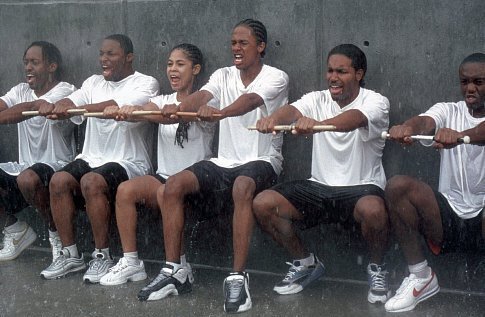
Apparantly when I was a teenager I missed out on a major part of adolescence. That is, the part where you pick some random, mildly gay, fundamentally uninteresting extra curricular activity - like frisbee tag or ham radio - and then immerse yourself in the secret world of its cutthroat, hyper-competitive, elite upper tier.

This was the message I gleaned from the current fad of movies where teens take their extra-curriculars waaaaay too seriously. As my post title indicates, I'm referring to these movies where unknown teen actors play high schoolers who balance complex social lives with their struggle toward the national championships of.... A capella singing. Or ice sculpture. Or capture the flag.

And this message comes to you bullshit free. Which is to say, I've actually SEEN these movies and can report faithfully on them. I have seen Bring it On. I sat through Drumline. I watched several scenes of "Stick it" - and, most tellingly, I saw most of "Center Stage" - the movie that dared to portray male teenage ballet dancers as macho guys. I will say in my defense that all of these viewings involved being over at friends' houses, deciding to watch a movie (from the friend's massive DVD collection), and then letting the friend's wife/girlfriend make the choice. The wife always gets to make the choice, doesn't she?

(And just a little aside on that. The unwritten rule of wife-makes-the-choice has resulted in me watching a whole lot of crap. The Heath Ledger one where he's the knight? The Drew Barrymore one where she's the princess? I drew the line at American Pie. I still refuse to watch that. Why doesn't any wife ever want to watch, say, The Score with Robert De Niro and Edward Norton? Wouldn't she be the coolest wife of all time?)

So these movies cover a diverse array of gay extra-curriculars: the four I mentioned are about Cheerleading, Marching Band-ing, Gymnastics and Ballet. All of them activities that a few dudes, for whatever reason, choose to participate in.


Out of these four, the most ridiculous by far is Drumline. These are marching band drummers who have turned the gentle art of halftime music into some kind of martial and aggressive interpretive dance of anger and ferocity and badassedness. They've managed to change halftime drumming from the poofy-hat-wearing effeminate display that it is - the sad performance of people who can't actually BE on the team yet still want to participate - into this macho peacock strut thing. It is, simply, the stupidest idea of all time. And moreover, the drummers of one team "battle" the drummers from the other team - challenging each other in that special "you got served" style of coordinated dance - a method of demonstrating superiority that seems to be reserved exclusively for people with both intense pride and nothing whatsoever to be proud of.

And I do want to take a quick second to point out that the drummers in Drumline have practice uniforms.


Meaning, when you show up for drumming practice, you presumably need to be wearing your drumming practice shorts and your drumming practice shirt. If you showed up for, I repeat, drumming practice, in a regular old t-shirt and shorts, would they kick you out? Would they yell in your face, drill sergeant style, about commitment and honor as you stood at attention with eyes forward?

But just how fictional is this whole culture of macho, in-your-face, halftime drumming? According to some of Drumline's imdb reviewers, these badass drummers are quite real. Here are some real quotes from the imdb...

#1
I marched in one of these bands (Southern University in Louisiana) 20 years ago and back then, band camp was FAR MORE INTENSE than anything you see on the screen in this movie. YES, it is that competitive. YES, it is that grueling. YES, it is that disciplined. Black College marching band is serious business and this film gives you only a small sample of what it takes to "make the band."

#2
Performing in a competitive marching band is HARD work. Everybody thinks the football players have a rough practice. We would practice on the field adjacent to the football team. We would be on-line ready to march at 0700. The jocks would ramble in about 0900. We'd practice 'til noon, have a 1 1/2 lunch; practice again until 5:00 pm. The footballers would leave at noon and not return to the field until 6:00pm. After dinner, we'd continue practice 'til 9:00 - 9:30 pm...My point in all this is everybody thinks band members are a bunch of weenies. Well they're NOT.

Yes. Yes you are a bunch of weenies. You're taking your little halftime show waaaaaay too seriously. Let's think about this for a second. Why would a person join the marching band's drum squad? Seems to me there are maybe two reasons. You like drumming, and/or you want to support the football team. What am I missing? How did this harmless activity morph into "battling"? You're twirling a wooden rod and doing synchronized percussion and dance. That's Ga-Ay. How is this something that you can stake your ego on? It's the friggin halftime show. You're the entertainment. Your entire purpose in the stadium is to provide an alternative to taking a piss. The more serious you take the drumming, the less serious anyone can take you. I mean, if your school janitor came home with a trophy from the national mop finals, could you take him seriously either?

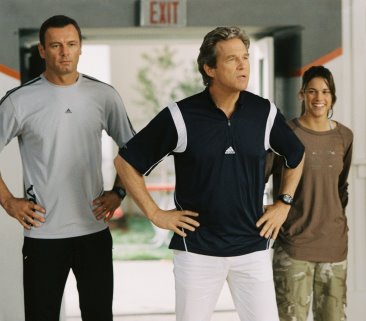
Another feature of these extra-curriculars movies is that they get some very, very low star wattage courtesy of a b-list actor playing the coach. Is there any surer sign that you're a has-been actor than when you get cast as the brooding coach in a teen extra-curriculars drama? Observe Jeff Bridges and Peter Gallagher:


Remember when teen movies were significantly better than this? Or is my nostalgia clouding my judgment? We had Better off Dead. We had Ferris Bueller. We had Revenge of the Nerds. We had the pouty angst of Molly Ringwald and the stereo-over-his-head-holding John Cusack. Naturally, a Duckie or Booger sidekick was standard issue. We had Spicoli ordering pizza in class. We had a hot chick materialize out of Anthony Michael Hall's computer. We had Val Kilmer holding a penis-extender. These were the salad days. The John Hughes days. A whole era defined by that eye from Porky's peeking into the girl's shower room.


Booger = Good


Jeff Bridges = Less Good


What do we have now? Taj? Stifler? The comedy stylings of Ashton Kutcher? These are dark days for teen cinema. Where is Christian Slater and his underground radio station? Where are the cliques of girls all named Heather? I say for shame. Enough with these modern teen comedies where the "joke" is that someone is tricked into drinking spooge. Enough with the teen dramas where the pathos is provided by ascending to the highest competitive levels of Bake-Offs or Indoor Climbing or Darts or Mock Congress.

Napoleon Dynamite aside, this generation has nothing on the teen movies of yore.

I want my two dollars!

Tuesday, December 19, 2006

The Ethicist, Part 2

Dear Ethicist: I have a strong suspicion that my landscaper Manuel gave me forged Social Security paperwork. Moreover, I am increasingly convinced that he is, in fact, the "El Paso Strangler" who's responsible for almost 20 border murders this year. They sure do look identical, right down to the telltale parallel neck scars. Should I call the cops, or just turn a blind eye?

Randy Cohen: How dare you. How dare you sir. It must be nice, living in that comfortable house with the landscaped garden, sipping on Chardonnay and listening to the crackle of the fire - while all the time Manual stands out in the cold, performing back-breaking physical labor for slave wages, all so that you can have a manicured driveway. Shame on you. Do you KNOW that the documents were forged? You say he's a criminal - are you a criminal investigator by trade sir? You sicken me. A person risks life and limb to immigrate to this country, seeking nothing more than a honest job and a future for his family, and your only thought is to persecute him. Does his brown skin scare you? It does, doesn't it? Does it fracture the ediface of your sham of a house of cards of a blah blah blah blah blah blah blah blah blah blah blah blah....

You see, one of Randy's common tropes is that we all should aid and abet illegal immigrants, underground railroad style. We should be out there setting up water tanks along their ingress routes. We should deliberately overlook fake paperwork. And of course we need to make everything available in espanol to ease their burden. And "ethically", what's his justification for the willful lawbreaking? Well, his argument is that an unjust law need not be obeyed, and our immigration law is unfair, cruel, and a shambles.

Let's consider. Yes, an unjust law can be righteously broken, but..... don't you have to have an overwhelmingly strong case that the law is unjust? Is it acceptable to simply go with your gut? Can we, as individual citizens simply decide that laws 3, 16 and 41 are unjust and then just casually disregard them? Thinking that our immigration policy is unjust and/or disfunctional does not meet the rightous lawbreaking standard by a huuuuuge mile. Randy has a misguided admiration for the nobility and work-ethic of the lawbreaking alien and he confuses his passion for their plight for some kind of solid conviction that immigration law is unjust.

I want to take a moment and try to wrap my head around the logic of Randy's immigration position.

Okay, so we have these jobs out there in agriculture and construction and meat-packing, etc. which we are told "Americans just won't do." Why won't Americans do them? It feels like the implied answer is that we Americans are fat and lazy, and our Mexican friends are just more industrius by nature. But of course that's not the case. We have a globe-straddling economic empire and they have abject poverty and rooster fights. The reason Americans "won't do" the agricultural field labor is that - given how arduous, backbreaking and unpleasant it is - and given that it pays $2.30 an hour - and given that it's 6 days a week with no benefits, perks, or any legal recourse for complaint - well, you'd have to be pretty damn desperate to take a job like that.

It's not that Americans won't pick lettuce, it's that we seem have a national shortage of starving, indigent, frightened, illiterate, desperate people to enlist into slave labor. And this, according to the logic of Randy and our other enlightened and progressive friends, is a BIG PROBLEM.

When they say "Our economy can't run without migrant labor." what they are really saying is "Our economy can't run without a steady supply of miserable, impoverished human beings risking their own lives to come here and be our indentured servants." This, once again, is the "progressive" perspective.

It's never phrased like that though. It's tarted up in the whole kum-ba-yah, help-the-poor, what-are-you,-a-racist? routine. You really need to consider the logical end result of the Randy Cohen immigration philosophy.

If we put all the illegals on a citizenship path - then guess what? The moment they become Americans they cease being desperate enough to take the inhuman field labor jobs. Now we need *new* illegal immigrants to do that work. Am I the only person on earth to realize this? That the "Jobs Americans Won't Do" argument, and the "Bring them out of the Shadows" argument are completely contradictory? As soon as we bring them out of the shadows and give them access to welfare and unemployment and medicare and social security and all the rest, they won't do the "Jobs Americans Won't Do" anymore - and we'll need to import a new freshman class of miserable, starving slave labor.

"Which is why we need a Guest Worker Program" comes the response. And the mechanism that will keep them from overstaying their permitted guest allotment time is...... what, exactly? It's utter fantasy to expect that the Mexican "guest worker" will say to himself "Well, my job's done here. Time to go back to my family in Oaxaca." Unless the guest workers are working with ankle shackles, chain-gang style, why would a single Mexican elect to obey the law and return home, when all 90 of his cousins are living here illegally, making more, and on a "path to citizenship"?

I have to say this one more time, because it really does blow my mind. The PROGRESSIVE opinion, the LIBERAL and ENLIGHTENED position on immigration is that we need a permanant caste of second class citizens to tend our crops. The enlightened position is that the lifeblood of our economy depends on the failure of Mexico as a state, and the resulting desperation and poverty of it's inhabitants. We need the average Mexican to have a life so miserable and hopeless that escaping his own country and working for us for $2.30 an hour is his best plan.

If I say sensible things like "Seal the Mexican border air tight." then I'll be called a racist. If I say "Citizenship should be contingent on true English fluency, a respect for our laws, an admiration of our way of life, a working knowledge of our history and civics, and some useful skill that we need more of." then I'm a racist. If I say "We should be working toward helping Mexico stand on it's own two feet so that it's people don't dream of sneaking in here." then again, I'm a racist. If I say "Americans should do field labor for real market wages." then I'm naive.

But that's how it should be. Yes the price of produce and textiles will go up. But that in turn spurs innovation - he who can build the automatic bean-picker will make the money. And building the automatic bean-picker is the true goal, because, really, NO ONE should be out there doing the back-breaking bean-picking labor. (with apologies to Mario Batali of course)

Well there. I went and did it and got all political. But man it gets me steamed. These pro-illegal-immigration people are like the homeless advocates who work tirelessly and zealously to achieve their noble goal: that every homeless person can be out there legally - begging, squatting, panhandling, loitering, sleeping on steam vents and in the subway - what a tremendous victory!!! You win, homeless advocates! They do have the right to beg and live in squalor on the street! Go on, do your victory lap, what a tremendous accomplishment!

Saturday, December 16, 2006

The Ethicist

I have been absent here for a while. Laziness is the real culprit - not a shortage of irritations by any means. It's just - it will always be easier to head out for poker and beer than to sit down and write about how much I can't stand the elderly. (And I do. They're awful.) But I was stirred out of this stupor by Time Magazine's predictable barf-worthy choice for Person of the Year.

2006 was really one of your standard off-years that you get periodically. This is one of those years where you find a philanthropist or a scientist and give him the limelight. Some guy in Japan made a synthetic immune system cell that will be responsible for major cures in 10 or 20 years? Perfect. Give it to him. If you absolutely have to make it political, give it to the Iranian president. Show him on the cover with bones all around like the Hitler cover in the 30s.

But again, it's this bullshit where it's the common man. Thanks, Time. The message? There are no great men. Great individuals are probably frauds. William Buffet gave away so much money this year that the effects will be rippling for centuries. But somehow, he's not going to be getting too many invitations to speak at commencement. And he wasn't in the running for POTY. I guess he's a villain for making the money in the first place.

But I get too queasy thinking about POTY. Let's talk about the Ethicist, the weekly column in the New York Times Magazine. This is Randy Cohen's column, where people write in with their ethical dilemmas and Randy gives his advice.

For a while I was a huge Ethicist fan. More than anything, it was great for dinner table conversation. I have a mental file of great Ethicist questions that are always fun to chew on. I started out agreeing with Randy Cohen nearly all the time. I still think that in some categories, he has a nearly perfect batting average. He's particularly good with "Who should pay the bill?" type questions. And the "Should I interfere?" questions - he's strong there too.

But.... whenever the question being asked has just the slightest whiff of politics to it, Randy the considerate and even-handed guy morphs into his own little Mr. Hyde where logic can be conveniently discarded in the quest to arrive at the solution that legitimizes every little white-guilt fixation he has (and he has them all).

The reason I began disagreeing with Randy more and more was that he started publishing more of these kinds of questions. Nowadays I'm maybe 50/50 with the Ethicist. And that's pretty poor. But what am I supposed to do when he leaps at any opportunity whatsoever to bash corporate America, the rich, the legal system, the military, chain stores, flag wavers, the religious, smokers, etc. Maybe when he's not concentrating he reflexively bashes Israel too and then has to hurriedly tap on the delete key. One problem I'm going to have here as I vent about Randy Cohen is that I really should footnote all these accusations with direct references to the columns themselves. The problem is that the New York Times has been very efficient in locking up all its content under paid subscription. Good luck finding a single old Ethicist column floating around cyberspace. Furthermore it will be a cold day in hell before I shell out a dime for Times content. So the bottom line is I'm going to have to rely on memory here.

Of course, I do have free access to the current column, and it was this column that got me annoyed enough to forgo the poker and beer. Here you can see the nauseating side of the Ethicist on full display. The side where accusations of racism fly fast and free. Share and enjoy:

Last Christmas, I took my grandchildren to “The Nutcracker,” a ballet I love. My enjoyment was severely marred by the appearance of a black snowflake and then, even worse, a black Snow King. The aesthetic incongruity was inconceivable. The entire ballet was spoiled. It is analogous to a one-legged midget playing Tarzan. Does this make me a racist? Name withheld, Sewell, N.J.

Randy's response:

This does make you a racist — not in the sense of exercising a virulent antipathy toward African-Americans but of being, like most of us, affected by feelings about race.

Here’s one way to think about your reaction. When you see “Gladiator,” the hero is not portrayed by a citizen of ancient Rome; he does not speak Latin. He is a New Zealander, and nobody complains (except a few carping movie critics who are just jealous of Russell Crowe). When you go to “The Lion King,” the title character is not a lion. Movies, theater, ballet — all are artificial. To experience them is to accept many contrivances. In Shakespeare’s day, men played the women’s roles, and people did not see this as an “aesthetic incongruity” but as a theatrical convention.

What prevented your doing likewise at “The Nutcracker” were your ideas about race. Remember, we’re talking about dancing snowflakes here, yet none of the dancers were crystalline specks of frozen water. The entire event eschewed any pretense of corresponding to the real world. What you call an aesthetic response is invariably more complicated than that, a product of many of our ideas.

Not so long ago, some folks would have reacted similarly to a Jewish singer in a leading role at the opera. But as anti-Semitism waned in America, so did such attitudes. As race-neutral casting becomes commonplace, I think you’ll no longer see it as incongruous; you’ll judge a dancer by her skill, not her race.

How enlightened! How progressive! If you object to a black snowflake on the grounds that snowflakes are supposed to be white, that makes you no different from anti-semites who objected to Jews singing opera! No different! Really, no different at all!

Randy mentioned The Lion King. He'd have no objection to an all-white cast performing the Lion King on Broadway, right? No objection whatsoever. (I mean after all, it's not like a *real lion* is being cast!)

How about Leonardo DiCaprio playing George Washington Carver in "The Peanut Butter Story"?

Randy Cohen: "Well now there you're dealing with a real person and the question of historical accuracy, and blah de blah blah blah."

Me: "Sure. Historical accuracy. So then you share my opinion that Morgan Freeman shouldn't have been cast in Unforgiven, seeing as, historically, he wouldn't have been treated as an equal and besides, there weren't any black, landowning cowboys in 1870's Wyoming."

Randy Cohen: "Well no, in that case it's okay, because b'blah b'blah-blah-blah, blahbuh blah."

Me: "Ahhhhhh, I see. Well then clearly you weren't bothered by that controversy where Angelina Jolie was cast as Mariane Pearl, the half-African, dark skinned wife of murdered journalist Daniel Pearl? You know how everyone was complaining that it was wrong to cast a white woman in the role? I guess you've made it clear we should judge the actress by the performance, not by the skin color.

Randy Cohen: "Well now hold on. That casting was inappropriate, not to mention insensitive, because blah blah blah blah blah di-blah blah blah blah blah open borders blah blah blah."

You know I had a professor once who snapped at me "Don't you think it's funny that no matter what the union labor dispute is, no matter what the issues are, conservatives always seem to be able to take management's side? They'll weigh the situation, they'll claim to consider all arguments, and yet somehow they always end up siding with management. Isn't that funny?" Well whenever I see Randy weighing in on a difficult racial issue, I always remember that little outburst. Isn't it funny how no matter what the individual circumstances are, Randy always finds a way to side with the non-white-skin-pigmented person? No matter what racial double standard he has to endorse, there's always seems to be a good, sound case for it? Funny, huh?

For example, a white man writes in and asks if it's wrong that he finds Asian girls prettier than all others and prefers to date only them. Is that racist? Yes, it's racist, says Randy, busting out his most aggrieved "How dare you" tone. Randy had the cojones to suggest that there was something illegitimate about this man's utterly personal choice about who to find physically attractive. Can you imagine living in Randy's world, where if you were caught dating a disproportionately high number of Asians you'd be subject to everyone's scorn? I have a followup question for Randy on his column. When I decide who to find attractive, should I be considering the racial demographic mix of just my local area? Or should I make some attempt at outreach?

But this is getting off topic. We were talking about the free and easy double standards. If a black man wrote in and said he found black women uniquely beautiful and preferred to date them exclusively, and does Randy have a problem with that, what would Randy's fiery, principled response sound like? I think it would sound like this.

I think Randy Cohen does in fact have a coherent position on these racial issues. It is this: If you belong to one of the cherished American victim classes, (non-white skin pigment being the most basic proof of membership) you are entitled to certain double standards. That's just how he feels. That's his position. It's a stupid position, and it shows that in all ways that count he's a lightweight, but it is coherent and consistent.

But of course he'll never come out and say that that's his position. Instead we're treated every week to these elaborate logistical cartwheels trying to demonstrate how a new racial double standard is ethically justified. Observe the flop sweat as he labors to show why black hospice patients can have racial nurse preferences but white patients can't. Throw a counterexample at him that uses his own logic but is clearly preposterous (Jews were oppressed - can they request Jewish nurses?) and then watch him discover a special footnote to his already confusing argument that disqualifies your counterexample. (Randy: "Jews don't have that same cultural fear of the white medical establishment." Me: "Ah, that makes perfect... huh?")

(Side note: Randy and I did have that back-and-forth. I'll at least give him props on responding to his reader mail)

How many times have we opened up an Ethicist column to read some bizarro, parallel universe question like: "My husband and I are remodeling our Greenwich country house kitchen. Just the other day, we noticed that the contractor has both an NRA sticker and a Right-to-Life decal on his worktruck. Is it justifiable to spit directly into his face, or should we just fire him quietly?"

Those questions are great for Randy because they set him up to be the voice of moderation. Randy: "As much as I sympathize with your predicament (and who wouldn't want to send a little salivary buckshot back in this guy's direction!) we must remember that in a free society, people are entitled to their opinions, no matter how unsavory." Bravo Randy!

To be continued...

Saturday, October 21, 2006

Automatically Getting Your Wisdom Teeth Removed

Guess what? I have all four of my wisdom teeth. Yeah that's right dentists. All there. All healthy. All helping me chew those spicy tuna rolls. What are you going to do about it?

See I know when I go to the dentist and they see those wisdom teeth back there the cash register noises start going off in their heads. They start thinking about that new backyard pool they're going to put it. That new corian kitchen counter. How crestfallen they always are when I tell them no sale.

Dentist: "You know Zap," (spoken in a fatherly, caring medical voice) "You really should get those wisdom teeth out."

Me: "Really?" (pause) "Why?"

Many people don't even make it to the why. They just give in right there and schedule the first of the appointments. Ask ten different dentists why, you get ten different answers. This is common:

Dentist: "Well, later on... they can become quite problematic."

Me: "Oh no.... what kinds of problems?"

Dentist: "Wisdom teeth grow for a long time. And when there's crowding in the mouth and the tooth runs out of jawbone space...."

Me: "Yeah...."

Dentist: "They can become *impacted*"

Me: "Oh God, no. What does that mean?"

Dentist: "It means it'll grow in at a funny angle."

Me: "And..... and what are the consequences of that?"

Dentist: "Um.... well they can become more prone to infection."

Me: "Infection? That's awful!"

Dentist: "Not to mention mild gum pain."

Me: "Oh Jesus. Not mild gum pain!"

Dentist: "And, possibly.... .... .... swelling."

Me: "NOOOOOOOOOOOOOOOOOOO!"

So yeah. This is not a convincing case to have four teeth removed. Let me ask a reasonable question. Where else in the entirety of medicine do we have body parts removed because of the hypothetical possibility that they may one day cause one of a few minor, perfectly treatable problems? If a buddy showed up with an eye patch and said "Yep, I had the eyeball removed. Can't be too careful about pink-eye." wouldn't that just be a wee bit stupid.

Ah, but the eyeball is useful. Not wisdom teeth. Okay, so what about the appendix? The appendix has no use. Do we get our appendix removed in anticipation of appendicitis? No.

The only things I can think of that we get preemptively removed before they cause trouble are moles and other skin blemishes. But a) those are unsightly, and b) the risk is cancer. If you bring cancer into the picture, then yeah, now I'll play ball.

If the wisdom tooth does cause trouble later on, then sure! Remove it! Oh what, they get more difficult to remove as they grow? I don't care. Still the same copay for me. Still the same anaesthetic. It's your problem, dentist.

And why do we play down the actual usefulness of a wisdom tooth? If you lose a tooth in early adulthood, any teeth that are still growing can move into the gap. Then you're going to be happy you had a few spares in the back.

I guess I just can't understand how people can be so acquiescent about forfeiting body parts just because one day they might get infected. "Might want to remove that middle toe... what if it steps on a rusty nail?" No thank you Dr. Hackemoff!

Finally, circumcision. Hmm. I guess logically I have to be against it. Yeah sure, what the hell, I'm against it. Not much I can do about it now though.

Wednesday, October 04, 2006

Music. Porn. Entering Nightclubs - Things I Refuse to Pay For

Let me focus on the music aspect of this, since I think refusing to pay for porn and clubbing is pretty straightforward.

Is it wrong to steal music? See, my position is, it's an irrelevant question. Technology has brought us to the cusp of the point where the protection of music is utterly unenforceable. If a law cannot be enforced, it simply ceases to be a law. If the government really made some sort of concerted effort to punish music file-sharers, in the style of Singapore littering punishments, then maybe I'd have to revise that opinion. But that's not going to happen.

I know that the opposing argument is "wrong is wrong, and getting away with it doesn't make it right." But there's a limit to that logic. If I patented the formula for coke, or I got a nickel for every coke sold, and then for some strange reason the sky started to regularly rain coke, then that's it. The ballgame is over. And that's what digitized music is. If your "product" is something that can easily be converted into ones and zeros and copied infinitely by anyone, then we are approaching the point where that product simply cannot be protected.

And if everybody wants something, and that something is free and easily accessible, and there's no way to curb the accessibility, and no way to enforce a law prohibiting it, then like I said, the ballgame is over. It's time to move on.

I do have a conscience that tells me that if something is simply "wrong" I shouldn't do it, but stealing music has not, so far, triggered that mechanism in me. I acknowledge that there is a long chain of hardworking people that brought the music from conception all the way to MP3 format, and that I am screwing them out of well-earned profit, but again, I turn to the fact that the sky is raining coke. It is not reasonable to expect that people will voluntarily refrain from listening to free music. Instead, it is the hardworking chain of people who will have to adapt to the new reality.

I anticipate something like the following happening in the near-to-mid future: music recording outfits will all teeter on the brink of bankruptcy, because everyone will be stealing their product. The government will have to intervene. Music making will have to be supported by tax dollars, with the expectation that the end product will be free for everyone.

In a way, this would restore a nice supply and demand balance. Music artists would have to settle for very normal wages (unless they make a fortune by touring, which they could always do) and the public, in the end, would resume paying for the music.

What's the alternative? "Enforcement"? Enforcement costs money. Someone has to pay for enforcement. It's our tax dollars that pay for it. Why not spend the enforcement dollars on subsidizing the musicians? What are the artists going to do? Boycott? They can't - they have no other skills. How would we decide who gets paid? Well, musicians would have to make music on their own coin; then they'd be paid on the basis of downloads or listens. The bigger the piece of the download pie you have, the more the govt. forks out to you. It's all nice and Darwinian.

Again, I don't really see much alternative to this future. You can't enforce a ban on file-sharing, and Kid Rock holding out his begging tin doesn't earn anyone's sympathy. Whether or not sharing files is still somehow "wrong" is going to have to become a question for armchair philosophers, since it's clearly not "wrong enough" to make people care at a sufficient level to actually enforce a ban. Technology has changed the rules of the game. Our old conceptions of how to protect intellectual property are going to have to adjust.

And yes. After music, movies are next.