Wednesday, September 28, 2005

Duke Nukem Forever

This is about Duke Nukem. If you don't care (and really, who does?) then skip.

DNF is a videogame that's been in production, full time, since 1998. It was sort of in production even before that - I know one magazine posted screenshots in December '97. DNF was (is / will be) the sequel to Duke Nukem 3D, a popular PC shooter.

I was a fan of Duke 3D. The gameplay was tight. It had a blend of humor, action and scares that worked well. It had plenty of secrets. Most first person shooters are all about multiplayer; Duke's focus was on the one-player game, and the story and scenarios were crafted well to reflect that. ... Of course, we're talking 1996 here. You wouldn't play it now. Unless maybe you were bored and in a VH1-ey kind of mood.

Videogames generally take about 2 years to develop. From greenlighting the project to mass production, it's about 2 years. Plenty of games take longer, and some less time - and historically the process has been quicker. I speak as someone who worked for a console game publsher for 4 years and watched it happen. Two years is industry standard.

What this post is about is making the following case: 1) 7-10 years of development for a videogame is completely unacceptable, from the point of view of anyone - a good-faith fan, a developer with any self respect, a shareholder of Take-Two Interactive. (Duke's corporate paymaster) - anyone. 2) 3D Realms' (Duke's developer) lofty and dismissive and sneering attitude toward anyone saying "Where's the game?" is nothing but obnoxious jackassery. It's the worst kind of arrogance - unjustified arrogance. And 3) That Duke Nukem Forever (when we finally see it) cannot possibly be any good. It is destined to fail.

Let me start by mentioning a guy named Arthur Laffer. He's the economist who famously drew the "Laffer Curve" on the back of a cocktail napkin. The conventional wisdom at that time was that if the government needed more money, it had to raise taxes. Higher tax rates, more money. Let's look at a graph, shall we?


Laffer's insight was to realize something obvious. Once taxes got too high, they would start having an impact on the amount of time people were willing to work. The more government takes out of your pocket, the more they're responsible for providing for your needs. At truly high tax rates people wouldn't work at all. Why work if the government takes 90 cents from every dollar? Better to stay home and let government provide for you. Laffer drew this curve.
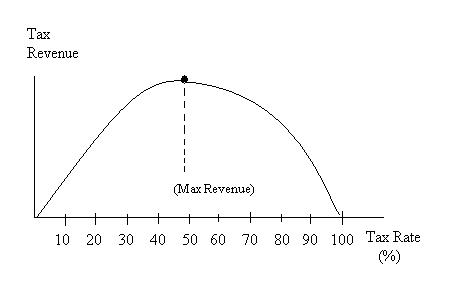

His point was that in a situation where taxes were high already but the government still needed more money, it might be better off lowering taxes to get more tax revenue.

It was a wacky concept, but today it's accepted as pretty much the truth. Now why am I bringing this up? I think Laffer would have had a lot to say about Duke Nukem Forever. Consider the relationship between the time a game takes to develop, and its eventual quality. I think the conventional wisdom might lead to a graph like this.
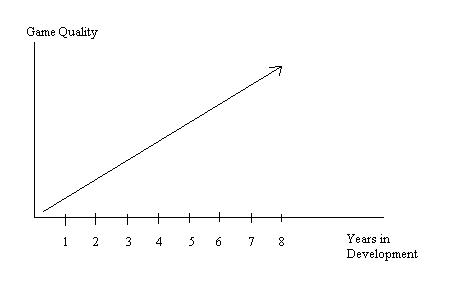

A straight line. Makes sense. The more time you invest in making a game, the better it gets. If you rush a game out the door early, it's going to be bad. Take longer, it gets better.

But then again, maybe that's not the full picture. Maybe it really looks like this.
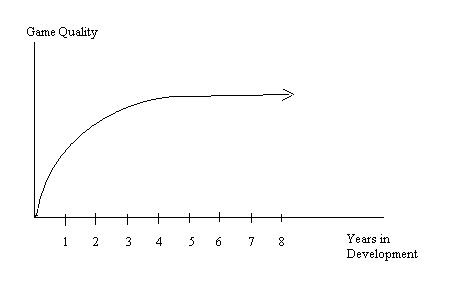

A sloping curve. A curve with decreasing returns. This makes a little more sense. During the first year or two of development you make great strides. But after many years of development, you approach the limits of how good the game can get. The team is only so talented, there's only so much money, you can only have so much content and so much fine tuning and balancing. So in the long run, quality starts to flatten out.

But this curve is also wrong. I'm here to introduce my own curve, Laffer style. This is what game quality really looks like over time.


It eventually declines, and finally plummets. Now this has to seem counterintuitive. After all, nobody goes to work and makes the game worse. Nobody sabotages art and animation. They work on the game and try to make it better. The problem is that at some point, this becomes as hopeless a job as bailing out the sinking Titanic with a pail. There are other, powerful forces at work; forces that are working nonstop, 24/7, inexorably, to make the game irrelevant and obsolete. These forces cannot be slowed down. With every passing day, Duke Nukem Forever gets less innovative and less pretty. It's gets less technologically impresive and less exciting to play.

It's like some guy with a beard down to his knees bursting out of a basement door saying "Finally! It's done! My sequel to Gyromite! It's taken 20 years, but I wouldn't compromise - it had to be perfect! It's the best NES game of all time!!!" After a certain point, no matter how skilled a game developer you are, your work in progress will be overtaken by the forces of obsolescence and it will be ruined.

But it's more than that. With every day the fanbase shrinks, the number of people who remember Duke 3D in any detail get fewer, the number of people interested in Duke declines, the value of the overall franchise starts to crumble. With no new product, and a mums-the-word policy from the developer, people forget Duke.

Plus, doesn't an eight year delay suggest, just maybe, that these aren't the smartest bunch of guys? Am I supposed to think they can make a good game when they've shown staggering incompetence in the planning of the making of the game?

Now, Duke bought itself some time (staving off obsolescence) by restarting the project with the Unreal Tournament engine in 2001. It threw out what it had so far and started from scratch with a more powerful foundation. Maybe that was a smart idea. But it was an idea with a fatal flaw. The idea presumes that you have the team, the resources and the skill to actually complete the game in about two years. If you can't do it by then, then guess what? You have another game that's nowhere near done and is approaching technological obsolescence. What are you going to do now? Start over a third time?

And then there are the rising expectations. The more time the game is in utero, the more we expect from it. DNF has been in production, full time, for 8 years? What does a game that took 8 years to make look like? What wonders will it contain? Now, if Shigeru Miyamoto retreated to a mountainside cabin for 8 years, cutting himself off from the world, monk-like, and devoted the time to crafting some exquisite new game of his own invention, well then now THAT would be a game worth an eight year wait. That game would blow your mind.

But head-up-his-ass, God-complexed, Hostess-snack-eating pompous asshole George Broussard is not Miyamoto. And Duke Nukem is not King Lear. It's a standard FPS that uses T&A and one-liners to distinguish itself in the crowded FPS marketplace. Or, rather, it did. In 1996. This middling franchise has earned 8 years to make its next game? Why? On what grounds? And its crack development staff is so gifted that we must not disturb their genius? We're not allowed to ask how it's coming along? Who else gets this priviledge? Why Duke?

Oh, you didn't know about the 3D Realms attitude about handling DNF inquiries? No questions are allowed. Broussard answers to no one. Not even the CEO of Take Two, his publisher. The CEO, Jeff Lapin, was fielding questions during a stockholder's meeting and was asked what the story was with Duke. All Lapin said was that he suspected it wouldn't be done in time for a 2003 release. (A sensible statement, considering it's 2005 and there's still no sign of the game). Broussard's response (in an internet forum) was that Lapin needs to "STFU, imo". Consider that. Not only is George telling the CEO of his corporate parent to shut the fuck up, but he's doing so in his capacity as lead designer of videogaming history's most failed project. The game industry's perrenial laughingstock. The game that was given not just the Vaporware game of the year award, but a Vaporware Lifetime Achievement Award. Where does one get the balls? Perhaps from the same place one gets the ability to take a franchise like Duke and steer it down into a mountain.

Here's what's going to happen when DNF finally sees the light of day. It will temporarily benefit from the increase in buzz and attention that comes from being a game that was in development for 10 years. Duke's marketers will misattribute this attention as being a reflection of genuine enthusiasm for the game, which it won't be, and this will send them into an overdrive of superlatives - claiming Duke is the most covered game of the year, the most talked about, the most anticipated, etc.

The game will debut to reviews that will be unfairly negative. The urge to compare it to other delayed failures like Daikatana and to continue the 10 year habit of mocking it will be too strong. So it won't get a truly fair shake. But the reality is that it will be a passable next-gen Duke entry, not too weak, not too strong. But it will not blow any minds, and nothing about it will justify its gestation time. On this score alone it will be considered a great failure. Other shooters (made in normal spans of time) that are as good or better than DNF will come out both quickly before and quickly after Duke, further underlining how unecessary the 10 years were. The erosion of the fan base will have taken its toll, and this will be reflected in sales. Only about 5 guys worldwide are going to laugh at those scripted moments in the game that are tongue in cheek references to earlier Duke adventures.

The game won't recoup costs, and the franchise will not recover. And so now, finally, after years of patience, I say goodbye to Duke. I've been a fan all this time. I've waited. My hopes were high. But it's over. DNF will not deliver.

It's time to forget about Duke, move on, and chew bubble gum. And I'm all out of gum.

Monday, September 26, 2005

Dr. Laura

I am so sick of this woman.

In Vegas, our radio afternoon-talk options are pretty limited. Dr. Laura is on the most prominent talk station, and she's on every weekday from noon to 3, which is the time when I'm most likely to be on the road. It's either her, a stock program or a sports program - slim pickings. Again and again, driven to choose one of these three choices out of boredom, I end up saying "Well, I'll give Dr. Laura one more chance." I always regret it.

Let me expose Dr. Laura's one trick. Becuase, it IS just one trick. Here goes:

People call in with personal problems: relationship problems and family problems. The problems range from fairly minor tiffs to "my children just died in a fire" and everything in between. Dr. Laura listens, diagnoses, and advocates a course of action. The caller wipes away a tear and says "Thanks, Dr. Laura." Goodbye. Next caller. Okay. Dr. Laura's technique is to take any situation and make it conform to a preconceived 3-act story of problem/personal growth/resolution.

Dudn't matter what the problem is! Could be any problem at all! She's performing a magic trick - the same trick, over and over. The thing about these callers is, their problems are usually fairly complex; they're layered, they have shades of gray, they involve years of relationship history, they involve deep-seated behavioral patterns and psychological turmoil. These aren't simple problems with simple solutions. But Dr. Laura will take this problem, interrupt the caller as soon as she has heard enough of it to put it in one of her standard pigeonholes, and perform the magic trick. The magic trick is that surprise! Your problem is really quite simple! See, in the Dr. Laura philosophy, there are only about eight problems. There's the woman who's getting stepped on and has to assert herself. There's the lazy, weak woman who's shirking her obligation to God and husband. There's the woman who's boyfriend has some bad habit and needs to be given an ultimatum. There's the man who needs a wakeup call that his childrens' welfare is paramount and all other concerns are secondary. And a few others I might be forgetting. Once Dr. Laura has established which of the eight problems she is currently dealing with, she can cut off the caller - his role is over. Now the story proceeds to its climax. The caller knows she is being stepped on / abused, she knows it! Furthermore, she knows what she has to do! Why are we even wasting Dr. Laura's time with something so obvious? All that's left is a tearful acknowledgement from the caller that Dr. Laura hit the nail on the head, and it's another one in the books.

Dan Savage, who writes Savage Love, also has this kind of kick-in-the-pants, tough love style of advice giving. He'll tell it to you straight and he won't mince words. There won't be any sensitive preamble, and he won't be delicate. But Dan Savage is also capable of changing gears and acknowledging a difficult, complex question with no clear answers. He'll sometimes change his mind. He'll post responses from readers and experts who weigh in with divergent opinions. He's quick to say "Dump the Motherfucker Already" but he's equally likely to see a gray area and seek compromise. When have you ever heard Dr. Laura talk about compromise?

See, Dan is thoughtful. Dr. Laura is a parlour show. The people who admire Dr. Laura do so because of the one trick: here was a problem that seemed terrifyingly complex, but as it turns out it was really quite simple. Only Dr. Laura could have cut through all that underbrush to expose the real problem. She's amazing.

Is it normal to listen to a relationship advice program and find yourself violently disagreeing with the expert advice? Here are a few standard Dr. Laura concepts that just seem dangerously wrong to me.

1) If you're not in love with your husband anymore, what you should do is pretend that you love him... go through all the motions of loving him... in every way act the same way you would act if you really did love him. Then, in time, the love will return.

Me: Huh? How does that work exactly? What if there's some actual *reason* that the woman doesn't love her husband anymore, beyond the possibility that she's lazy and weak and is ignoring her duty and promise to God to love him always? You know, what if there is some actual *problem* with the marriage? Do you think maybe that's worth exploring? Nah.

2) Even though you love him, you should dump your boyfriend. He's a drunk (or a liar, or a cheater, or a gambler, or whatever) and people never change. Time to move on.

Me: Of course people can change you miserable shrew. Don't want to get sidetracked here, but when Dr. Laura was making her moral argument against homosexuality, wasn't the idea that men are naturally beastial and weak and lustful and somewhat savage and that it takes the love of a woman to temper man's sinful nature? This argument was making the rounds for a while. So that's why homosexuality is ultimately futile - because a man without the guidance and temperance of a woman's influence will always be a savage. How does that jive with Dr. Laura's frequent conclusion that errant men are incapable of change and should be abandoned? If the woman loves him, can't she work on him? Can't she help him? Shouldn't she "temper" him like she's supposed to? Why the contradiction?

And how about Dr. Laura's supremely condescending manner toward every caller? Dr. Laura is never, ever happy until she's made it clear that you're five years old and gotten you to admit it too. I think this is tied in with "the trick". Dr. Laura is the great simplifier of problems. She needs you to admit that you've been foolish, carrying on as if your problem had any nuance to it, any hint of a third dimension. You child. You ass. Don't you see how black and white it really is? Why are you hesitating? Kick him out and change the lock. Of course you go pick him up from the airport. She absolutely cannot get an earring.

You know, Judge Judy can get away with an attitude like that. She's talking to people who have broken laws and and misbehaved in a variety of ways. Maybe they need a little Judge-Judy dose of stern authority. But the people who are calling in to Dr. Laura are good, decent people who are doing something difficult - reaching out for help with the most personal kinds of problems. Seeking help of this kind is itself a gesture of humility. These people don't deserve to be ridiculed and belittled. Like your low level supervisor always reminding you that he's the boss, it's cruel and cheap for Dr. Laura to always squeeze every last drop of superiority that her radio-doctor position affords her.

Here, for your convenience, is every on-air Dr. Laura conversation that ever happened, condensed into about one page.

"Hi Dr. Laura, thanks for taking my call."

"How can I help you Denise."

"Well............ it's my boyfriend. He's been living with me for about a year...."

"How old are you?"

"I'm thirty six.... He was injured on the job last March.... He works for the Coast Guard...."

"How old is he?"

"He's my age.... He lost the use of his legs..."

"Denise....."

"And he gets around in a power chair....."

"Denise....."

"Yes?"

"Did I ask you if he was your age? I asked how old he was."

"I'm sorry Dr. Laura. He's thirty six."

"Okay, go on."

"He gets around just fine, and he hasn't really lost any of his independence. It's just that.... well... he's not the same man he used to be."

"Denise..."

"He doesn't seem interested in staying active..."

"Denise...."

"Yes?"

"Denise, what is your question."

"Well... okay... see we used to do everything together, but lately he always finds an excuse..."

"Denise you haven't heard me. What is your question?"

"What should I do Dr. Laura?"

"Do you have children?"

"No."

"Denise, he is either going to have to change his attitude in a hurry, and I mean soon, or he is going to lose you."

(silence)

"You know what the right thing to do is, don't you Denise."

"(sniffle). Yes."

"He is either going to rediscover his joy in life or he can be miserable all by himself."

"(sniffle). Yes."

"But he is not going to drag you down with him."

"(wipes a tear) Thank you Dr. Laura."

Wednesday, September 21, 2005

Naked Chicken

I saw this commercial for Naked Chicken. Go watch it and come back for discussion.
http://www.dhadm.com/index.php/dhadm/index/buffalo_wild_wings

Okay. Naked chicken. I saw this ad and it didn't really register. My mind processed it and filed it the way it does for most commercials. It was stupid but it didn't seem too offensive. But the more time passed, the more I kept coming back to this ad in my mind. Naked chicken.... The more I thought about it the angrier I got. Why was I getting so steamed about this commercial? Finally I could no longer contain my rage and just shouted angry insults at the Naked Chicken, cursing the chicken, cursing Buffalo Wild Wings, damning everyone who had ever eaten a naked chicken and all their family members too.

I still can't get a full grip on why this commercial angers me so much, but I'll try to talk it out.

First of all, we have a guy holding a blurry piece of chicken, and he asks the waitress why it is blurry. Now, I have to point out, just for my own sanity, that things in real life can't be blurry and pixellated. So this is the first point where the commercial is asking for my suspension of disbelief. No problem. You got it. People talk to cartoon characters in commercials, they wink at a Mr. Clean who's come alive on the bottle, same with the Brawny Guy, okay fine.

But now, the guy asks why his chicken is blurry. This is a red flag. I, the viewer, have suspended *my* disbelief. "Chicken can be blurry." I've told myself. I've accepted that. It's weird and uncomfortable, but I've made peace with it. But now the guy in the ad doesn't quite understand it either. My suspended disbelief is collapsing like a house of cards if the guy in the ad is questioning blurry chicken. He's supposed to be on board with it. Now I'm back to square one: why does the chicken have some sort of computer effect on it that people can see?

The waitress comes over, all smiles, and helpfully clears up the confusion. But this is another request for suspension of disbelief. If I'm meant to question the nature of blurry chicken, as the guy in the ad did, shouldn't I be considerably more freaked out than he is? Wouldn't I be shook to my very core that the chicken was blurry? Wouldn't I be freaking out? That his blurry-chicken-crisis is so easily resolved doesn't ring true. This is a much more difficult request for suspension of disbelief. Buffalo Wild Wings is asking me to accept that chicken can be pixellated, but not immediately - only after some casual questioning. This challenges the very limits of my suspension of disbelief abilities. It's as if you saw a Mr. Clean commercial where Mr. Clean comes out of the bottle and congratulates mom on a clean kitchen, and you find it amusing, but then mom freaks out that Mr. Clean has come to life, and now you're confused and frightened, but then Mr. Clean says "Don't worry, I do this every Wednesday" and mom calms down immediately. Huh?

So as I struggle with this, the commercial doesn't get any easier to understand. The waitress explains that the chicken is censored because its naked. Now, further SoD is required because guess what? That doesn't make any sense. Even if I could pixellate things in real life and cause only mild, temporary confusion in others, chicken is naked to start with and doesn't need to be blurred. Shouldn't the guy in the ad say "Isn't 'naked', in this sense, only referring to the absence of breading? And since when have we been modest about chicken nudity?"

But, well, this is all a joke. Ha ha. Naked Chicken. Get it? Not really, no. It's not funny. No. Just not funny. Nobody in the ad is behaving like an actual human being. And note the fleeting look of distaste of the waitress's face as the ad ends. Is she annoyed because the whole "blurry chicken question" is something she has to explain 20 times a day and she's sick of it? Or because the one guy is waving his blurry chicken around like an idiot? An open question, I guess. There's so much groundwork that has to be laid for this lame punchline that the whole thing is just a confusing waste of time.

Again, I ask: remember when commercials were just "The Lincoln Towncar. Magnificently designed and appointed. Luxury you can afford." and that was it? There was no triple-layered irony and forced humor?

Sunday, September 11, 2005

Auto Mechanics Adjusting my Seat Setting

This is a situation that just recently brewed to a boil. For a year now, I've been taking my car to this one Bridgestone garage here in Vegas. Mostly just regular tune-ups.

And every time I get the car back, the seat is a) scootched way, way up, b) brought up from its reclined angle, and c) vertically raised. Sometimes d) the rear view mirror has been readjusted, e) the driver's side mirror, and f) the steering wheel has been lowered.

Okay, I didn't even know you *could* lower the steering wheel. I had to hunt around for the switch that brings it back up. Aside from the fact that they seem to be employing Herve Villachez as a mechanic, there is absolutely no call, none, for them adjusting any of this stuff when they give me an oil change. And I've known this for some time; I keep making a mental note, everytime I leave the garage, to tell them next time not to change the settings.

To give you an idea. Here's what goes on. I park in the Bridgestone parking lot. I walk in. I request service. I give them my key. The mechanic takes the key, enters my car, and drives the approximately eight and one half feet to the interior of the body shop. Later, he makes the same trip, in reverse, back to the parking space. And for this he has to LOWER THE STEERING WHEEL.

Well this time, I finaly remembered to bring it up at the counter. This was pretty much the conversation:

Me: "Oh, uh.. hey. Could I ask for uh, one small favor?"

Bridgestone Guy: "Sure boss, what's up?"

Me: "Could you tell the mechanic.... not to change the setting of the seat. ... ... In the car?"

BG: "The setting? What do you mean?"

Me: "Well, it's just that, every time I get the car back, the seat is always scootched way up."

BG: "Oh no, we don't do that."

Me: "Oh I know you don't. It's just, you know, the guy always scootches it up."

BG: "Well, hey, sure. It's not a problem."

At this point the guy writes a note on the work order... "Customer requests... do not adjust seat." Now I know I'm screwed. Now I am ensuring that this mechanic will just hate my guts and do something awful to the car. I also really want to bring up the wheel adjustment and the mirrors, but I know not to press my luck.

Two hours later (they were replacng brake pads) I get back in the car. The mechanic left the floor paper inside the car. You know how they put a paper on the floor of the driver's seat to not get it dirty? Well, he left it in there. The seat? Not adjusted. The mirror? Way out of whack. The steering wheel? Lowered all the way.

Well I'm not going to seek any further justice on this. I don't think you want to get on a mechanic's bad side. But let me just pose the question. Are you so worried, during the 10 second drive from the parking spot to the garage interior that some reckless driver in the fast lane is going to ride up into your blind spot at 60 mph that you need to mess with the side mirror? You know, if I'm hiring a guy to drive my car cross country to some other city, by all means, adjust everything. In fact, if you want to leave some fast food wrappers on the floor, no one's going to say anything. But if the amount of time it takes to mess with all the settings actually exceeds the amount of time you're going to spend driving the car, maybe you should leave it the hell alone.

Saturday, September 10, 2005

Registered Trademarks

One more thing before I leave the Starbucks topic. I occasionally buy a bottled fruit smoothie there; one of those healthy, alternative brand smoothies that they keep in the refrigerator case.

You know how all those little fruit-smoothie-in-a-bottle brands are all going for that hippie, Ben & Jerrys asthetic? The little smoothie with the rainbow on it, or the cartoon drawing - its very existence seems to be a rebuke to the cold, cruel, Minute Maid juice empire. This is a rogue, underground smoothie. A smoothie that doesn't play by the old rules. It's a new, hip, enlightened kind of smoothie, one made in a socially responsible, eco-friendly, diversity respecting sort of way.

Let me read you, verbatim, the text from the smoothie label. Note, this is an Odwalla brand, "Citrus C Monster" smoothie. Also note, the font here on Blogspot won't let me use the symbol for a trademark or a registered trademark, you know - the "r" with the circle around it or the tiny "TM". So I'll just indicate where they appear in plain text. Okay....

Citrus C Monster (registered trademark)

Easy to C. (trademark) This sweet, C - ferrying smoothie is a blend of orange juice, peach puree, apple juice, pureed guava, pineapple juice, acerola cherry juice, raspberry puree and passion fruit juice. Vitamin C is an important antioxidant that you body needs. It neutralizes free radicals and plays an important role in supporting a healthy immune system. With multiple sources of Vitamin C in a delicious multi-fruit smoothie, this Monster is a wonderful way to "C for Yourself"(registered trademark). To read some nourishing stories, visit our People to Planet (registered trademark) page at www.odwalla.com.

All right. Do you think the happy, silly, whimsical intent of these phrases here is just slightly undermined by the constant legal reminder that those phrases are protected by trademark? You're trying (desperately, I think) to generate these warm, gushy feelings in your customer base, and at every turn, you are hinting that you will not hesitate to unleash your lawyers and sue their asses back to the stone age if they just try and use your whimsical phrase without permission.

Let's say I trademarked the phrase "I wuv you!". Now say I send you a bouquet of flowers and a card saying "I wuv you!" (registered trademark) Wouldn't that be a profoundly disturbing message? Wouldn't you put down the card and back away very slowly?

The r-with-the circle-around-it means only one thing. It means WE HAVE LAWYERS ASSHOLE. YOU WILL BE SUED.

And what gives Odwalla the balls to think so highly of it's stupid little trademarked phrases? Do you really think, Odwalla people, that there is a single person on this earth who has been tempted, even for a second, to steal the phrase "C for Yourself"? Has anyone, even for a moment, been impressed by naming your website "People to Planet" - like you and you alone are the first people to think of making a consumer-interactive website, or you and you alone understand the rich subtlety of how a website can unite people over great distances?

Or do you not care about any of that, and "C for Yourself" and "People to Planet" is just a desperate bid for whimsy, because that's what you think sells smoothies?

Okay, I just visited the website, and man does it reek of incense and unwashed feet. Apparantly, they have a unique process for making juice called freshalicious. No, wait a minute, let me go back and make sure... no, it's actually Freshology.

Don't you understand (and now I'm talking to the general public) that the very existence of the word Freshology means that someone, somewhere has taken you for an idiot? I'm not anti-whimsy here, I'm not anti-fun, but Odwalla, you HAVE to TRY... HARDER. Trademarking your warm-fuzzy slogans undermines their entire reason for existence, it's useless to trademark them anyway because there's not a chance in hell anyone wants to steal them (If your legal department says different you can fire them) and you need to scrap Freshology. How about Frooteloo! or Freshgasmic! Those are free, by the way. They're all yours.

Thursday, August 04, 2005

The Genius of Starbucks

Once again, my hat is off to the genius of Starbucks. These guys are good. Really good. I've commented before about my amazement that they were able to force their stupid size names on us with very little resistance on our part, and that they succeded so spectacularly that now food service businesses everywhere use the Starbucks size names.

But they've succeeded in a new coup as well, and this one's a lot more subtle. I admit I only just picked up on it. Let me share it with you. It concerns the frappucino and all its variants.

The Frappucino is a milkshake.

That may not immediately seem like earth shattering news, but just stay with me on this. I noticed this because the other day, I was getting my morning coffee at Starbucks when two dudes walked in. Two guys, early twenties, friends, just stopping in for a little summer refreshment. They both order venti chocolate chip frappucinos (one of them reassuring the other that there's nothing coffee flavored in it) and they both get these enormous drinks and sit down, facing each other, insert the big straws and start drinking their frappucinos and talking.

Nothing out of the ordinary, right? Well, it made me think. What if, hypothetically, you changed the Starbucks into an old fashioned ice cream parlour. It's got the candy colored decor, the friendly old man who scoops your ice cream, the black and white tiled floor... Now, can you imagine the same two dudes walking in, approaching the counter, buying a pair of chocolate milkshakes, sitting down opposite each other at a cozy table and sharing a relaxing conversation? Two dudes, drinking milkshakes. Together.

No, I really don't see it. It just wouldn't happen. Guys don't turn to other guys and say "Hey bro, you want to go down to the old ice cream parlor, get a milkshake and hang out for a while?" No guy would say that. They might as well get a couple of parasols and skip down the street holding hands.

But the frappucino thing goes way beyond tricking dudes into sharing a milkshake. The frappucino has single-handedly revitalized the milkshake business, which, let's face it, was not too strong. Peek your head inside a Baskin Robbins. (mmm, fresh waffle cone) Is there anyone in there? No. Even if there is, is anyone buying a milkshake? No.

No one wants to buy a milkshake because milkshakes are terrible for you and everyone knows it. It's easy to scarf down a burger and excuse it. To eat a cookie or a doughnut once in a while. But there's something about ordering a milkshake, I think, that just lets you know you've gone too far. A milkshake has to be preapared. You have to request its creation. It's not just sitting on a plate making you feel like if you don't eat it it will just go to waste. You need a special store or special equipment to get your hands on one. We as health conscious consumers have managed to reject the milkshake.

But suddenly, Starbucks changes the name to frappucino and it's open season. (I went and actually looked up calorie comparisons of milkshakes and frappucinos and they're basically equivalent. If you don't believe me, look it up yourself. I lost the link.)

People are actually drinking frappucinos every day and they're completely oblivious to the fact that they've got a daily milkshake habit. And if they knew they were consuming a milkshake every day I think they'd be horrified. And all this Starbucks-invented lingo... "extra pump", "no whip" etc. etc. I think the lingo exists purely so that the deception can be maintained. So that there's no mental connection between the beverage you just ordered and an extra-large milkshake, which is what it is.

Starbucks, basically, is a religious cult. They have an invented language meant to disconnect you from reality. They "love bomb" you with tasty forbidden treats to get you hooked. They play a non-stop patter of soothing, non-threatening jazz. And then before you know it you're dead broke and you've gained a pant size.

Wednesday, March 09, 2005

End of the Line

This is it. We've had a good run here on Petty Annoyances, but I'm bringing this journal to a close. Not permanently, maybe, but for the forseeable future. When I started this thing I had a huge, out of control list of things that irritated me, annoyed me and just generally pissed me off. Thanks to the magic of the internet though, I've been able to faithfully report all these things, and have even thrown in a few new ones as they came up.

But now the well is dry, so to speak. It's time to go live life a little more and find brand new things to complain about. Perhaps in time, I'll be overflowing with rage again and will return to this trusted forum to spew the bile. One can only hope.

Some things I was planning to write about but could never really work up the umph for: the mighty badness of the Star Wars prequel trilogy, the profound ugliness of a car door opening at a red light, a head emerging, and a thick loogie slowly descending - and the fact that although the movie Psycho featured arguably the greatest single performance of any movie, the finest direction of any movie, the best score and one of the best scripts, it was denied nominations for any of those things at the 1960 Oscars. But hey, The Apartment. We watch that Jack Lemmon classic allllll the time, right?

So I say thank you to anyone out there who's enjoyed these whiny essays, and, like the majestic hawk, must now fly away deep into the high, high mountains, where, being a hawk, I dwell exclusively. On the bright side, I've always wanted to be able to say I was putting something "on hiatus" for "retooling" and now I can.

I leave you with a look at the brighter side of life, because one can't be negative all the time.


20 Things I Like

1. When the dryer lint comes cleanly off the screen with a single snap of the wrist

2. Boolean modifiers

3. Removing your feet from ski boots.

4. Any commercial with William Shatner

5. Toilet paper with some bite

6. Porn DVD commentary

7. The names Launchpad McQuack and Judge Learned Hand

8. Pulling up to the parking space exactly as the song is ending

9. The funky, staccato, syncopated vocal cadences of CNN's Richard Quest. When the guy speaks it's like jazz improv.

10. Using the rare but grammatically correct "Sons of a bitch." when insulting brothers.

11. Dreaming about what you'd have done to the thief if you'd have caught him red handed.

12. The terms fracas, melee, brouhaha, hubbub, foofaraw, hullabaloo, and kerfuffle.

13. Rolling a hard eight

14. Barbershop chairs that face away from the mirror. This is genius! I never realized how relaxing a haircut can be when you're not staring into your own eyes for 20 straight minutes. Plus, no mirror, I can completely ignore the barber's craft. I go from unkempt to well groomed with absolutely no information about the transition. This is really how it should be.

15. Ben Stein

16. When you and another guy at the urinal start peeing at pretty much the same time. And you keep going, and he keeps going, and you keep going, and it's looking to be a real marathon, and you make an effort to pace yourself, and it gets to the point where you have serious doubts if you're going to win this one - but wait! He's wavering... he tinkles to a stop! You're still in the zone! Victory!

17. The laughable No U-Turn sign. Ha! No one enforces you!

18. Need a penny, take a penny. Have a penny, leave a penny.

19. Happy old toothless guys. Generally I don't like old people, but the happy old toothless guys who you find at the poker table are your instant best friends. They were crane operators for 50 years, or sanitation workers, or whatever, and they'll be glad to tell you how much fun it was. They have an endless supply of great dirty jokes, they'll drink all night, they bathe with surprising regularity, and they have that great smile that just makes you think "Yeah, I could pick up that spare." Happy old toothless guys, I salute you.

20. “He peppered in God’s lo mein.”

Thursday, March 03, 2005

The Ice Cream Man

I hate you, ice cream man.

Every day, for two full hours, the ice cream man makes his rounds outside my bedroom window. He's there from 10 to 11 am, and then there again from about 3 to 4.

This guy isn't a Mr. Softee or some sort of national ice cream truck outfit. He's just a dude with a shabby looking mexican coyote van equipped with a loudspeaker. As a convenience to residents in my complex, the front gates are left open during business hours to keep traffic moving. In comes the ice cream man. He circles our little block endless times, the schreechy little synthesized song playing over and over in a 15 second loop.

We have plenty of kids in the complex, which is why he's so happy to be here. Our complex has a no solicitation rule, but it isn't enforced. At the end of my tether one time, having listened to this 15 second high pitched ditty for the 6 thousandth time in single day, I went to management and begged them to do something. They get lots of complaints, they say. They've told him to go away, they say. He agrees to not come back, they say. And then he comes back, right on schedule.

One time I woke up at 3am with the song playing loudly and perfectly in my ears. (The song is kinda like "Over There" except weirder and shorter) It was playing note-perfect in my head. It took me a minute to realize I was hallucinating it. My first thought was simply, "No!!!!!! Not now, ice cream man! Mercy! Mercy!"

Imagine the scene on another day. A frigid January morning. About 10:00 am. A steady splattering of freezing rain. The sort of morning where you huddle next to the heater with a blanket wrapped around you. And then... the ice cream man.... over therrrrrre..... over therrrrrre..... send the word, flip the bird, over therrrrrre...

Because the yanks are coming.
The yanks are coming.
The drums rum-tumming everywherrrre...

Repeat 50 times.

Mr. Softee would never hustle kids for a sugar fix on a day like that. He has better things to do. But not our ice cream man.

Sometimes I fantasize about visiting actual violence on the ice cream man. Pulling him out of his truck Reginald Denny style. Slashing his tires. Gouging him repeatedly in the face with an Italian Ice cardboard spoon.

If anyone can suggest some actual, feasable solutions for my ice cream man problem, or at least come up with some ideas for how to make his life miserable, I'd be interested and appreciative.

P.S. If there was really more to Acrobat than just the Reader, do you think maybe they'd stop reminding you after 10 or 15 years? You think? Just putting that out there.

Wednesday, March 02, 2005

120 Annoyances

101. The insane difficulty of the average text adventure.

102. The black Chuckle.

103. Someone walking in front of you - just fast enough that you can't overtake them, just slow enough that you can't get into a comfortable gait.

104. "Professional driver, closed course."

105. People who use the "[sic]" convention of preserving a misspelling within a quote for no reason except to belittle the author of the quote. So often in printed debate you see someone quoting their opponent and throwing in the "[sic]" like it's some kind of sophisticated riposte. If pointing out someone's spelling mistake is important enough to be included in your argument, then you're on weak ground, in my opinion.

106. The FBI Warning

107. An ice cold, unspreadable chunk of cream cheese.

108. Edutainment

109. Vince Vaughn as Norman Bates.

110. Children in a video arcade who desperately, pathetically try to glean a sliver of enjoyment by pretending to control a demo screen. I don't know why this angers me. I just want to smack them.

111. Fusion cuisine. Why are the portions so small?

112. Rhyming jail with bail. Also mad, bad, sad, and glad.

113. When you drop something - a paper clip, a quarter, a matchbook - and it's just gone. You look around, you look under the chair - everywhere, but it is just not there.

114. Fighting a losing battle for armrest real estate with a big guy on a plane.

115. When your loud turn signal really messes up the good part of the song.

116. Businesses with phone numbers that make you hunt around on your phone for the letters of the alphabet, and especially those whose spelled-out numbers exceed the 7-digit maximum. By the time you've realized it was a total waste of time to find the "E" and the "R", you've already done it.

117. Poetry in a foreign language that suspiciously still rhymes in English when it's translated. I'm no expert on poetry, but how can preserving the rhyme structure of a translated poem possibly be considered more important than preserving the authenticity of the text?

118. Warm, wet, spongy, undercooked pepperoni - the result of some pizzarias' moronic policy to cook the toppings under the cheese.

119. Eraserhead, Begotten and Tetsuo the Iron Man.

120. When you get on a really long line, and as you progress through it, no one gets in line behind you.

Monday, February 28, 2005

Potpourri 3 The Movie: Spell of the Unknown


Purchasing a Small Quantity of Toilet Paper
Why would anyone ever not buy the absolute largest package of toilet paper available in the store? If you're buying TP, don't you want to get the largest quantity you can? Why would you ever get the Charmin 4-pack? Do you anticipate not needing more than a 4-roll supply? TP doesn't go bad, it doesn't expire. You could fit a two year supply of it under the bathroom sink and still have plenty of room left in there. Why would you ever not buy TP in the biggest bulk you could carry out of the store? I don't get it. I recently lived in San Diego for 4 years and I think I bought toilet paper maybe twice.

The Da Vinci Code
Why is this so popular? What is the fascination? For years, this book has been a nonstop bestseller. I'm not planning on reading it, but I'd welcome an explanation. Many people have told me I *have* to read the Da Vinci Code. Oh my God, you have to read the Da Vinci Code! I don't want to be mean here, but have you ever known people that if they told you you had to read something, you'd be a little skeptical? I've gotten a lot of that with this book. (btw: I'm starting to think that "The Five People you Meet in Heaven" may also be heading down this road. Be wary of people whose literary judgement you don't entirely trust recommending this one.)

Stock Blurbs
How come, every day of the Iraq war, it was either "Stocks up today on war optimism." or "Stocks down today on war fears." Really, whatever direction the market was going that day they'd just spit out one of those two sentences, regardless of any actual news from Iraq. How does this make any sense? Can you cite war optimism, war pessimism and war optimism again as the driving force behind the market all within the same week?

Questions Asked by Pop Up Ads
"Should Bush have Won?" What kind of an idiotic, insulting question is this? Should Bush have won. Man. Well, if one believes that democracy is a just, fair process - and if one recognizes that Bush did win the popular and electoral college vote... well then yes! I guess he should have won! But wait, is the question really asking "Did Bush deserve his victory?" Ahhhh, a different question. Maybe I was wrong to judge the pop up ad so quickly. But correct me if I'm wrong, don't we already have an extremely accurate, nationwide comprehensive survey that addresses that very question, namely, the election? If the pop up ad really wants to get a sense of popular opinion on Bush's worthiness, do you think maybe the pop up ad should consult the official election results?

How about "Which one is Marge Simpson?" Ooooh I hate you pop up ad. Have you ever deliberately answered one of these questions wrong to see if the pop up ad has anything prepared for a wrong answer? Sometimes they don't, especially when a free DVD player or something is being offered for the correct answer. If you select Chief Wiggum the pop up ad goes through a bizarre hiccup and then returns back to the question.

I'd really like to see firsthand the person who squeals with delight when they see this pop up ad. The person who says "Wait a minute, I know Marge Simpson! I think I can win this thing!" I'm sure they're out there.

I think I'd like to buy a web ad to display on a random website, and the ad would say "If this banner is flashing, you've won!" and the banner wouldn't be flashing. And then if you clicked on it, you'd just get taken to a page reminding you that you didn't win, as the banner you clicked had not been flashing.

Wednesday, February 16, 2005

Planned Community Street Names

I think I may be having a rare change of heart. I use to be an enthusiastic supporter of these monolithic, ginormous cookie cutter planned residential communities. The kind that dot my suburban southwestern landscape like so many prarie freckles. People may poo-poo them for the bland sense of conformity, the lack of flavor and imagination, the artificiality. But I like to think that I saw past all that. These communities are convenient. They're centrally planned. They're kid-friendly. They have round the clock maintenance staffs (staves?) They have tennis courts. Homeless don't even try to set up shop. And usually, there's a monthly community newsletter - complete with a crossword puzzle that is delightfully non-taxing.

I've lived in a few of these places now. Very few complaints. But just a few weeks ago I had a bit of a rude awakening. I was driving out to a friend's house in a different part of town. As I exited the boulevard and entered the well-manicured driveway of the residential community, I picked up my handwritten directions. Left on... Redwood Ash... Redwood Ash... not Crimson Clover... not Elk Lake.... okay Redwood Ash. Now a right on Pine Glen..... hmm, not Sprucedale.... not Jade Cliffs.... not Sleepy River....

Then suddenly, unexpectedly, the truth hit me. "Wait a minute! This is all bullshit!"

Elk Lake? There is no lake, and there are no elk! Jade Cliffs? Wrong and no! Pine Oaks Bluff? There is no scenic bluff! There is no oak! And my friends.... there ain't no pine!

(FYI, this is Las Vegas valley we're talking about. It's nothing but parched, level, featureless desert scrub)

If a street is called Emerald Vista, does a person have a right to expect that somewhere in the vicinity there might actually be an emerald vista? If yes (and that's my position), doesn't that mean that streets with names like Emerald Vista should be relatively rare, seeing as how naturally occuring emerald vistas are somewhat hard to find?

And if you have three consecutive streets with the names "Cedar Forest", "Summit Point" and "Sea Palms", doesn't that put the lie to the whole idea that the street is named after some kind of organic natural feature?

I mean, let's be honest here. There are some ground rules that go into naming streets. You can name your street after a person - that's always a good choice. I live close to Jimmy Durante blvd and that's fine by me. Back east you could always use some local Indian word. Or hey, just make one up. Tuscalanat, maybe. Or Scatiteegwa. Out here it's even easier; you got "mesa", you've got "verde", you've got "paseo" - throw in a few caminos and you've got yourself a street.

But if you're going to go the time honored route of picking some feature out of the environment and naming the street after it, then by God, don't lie to me.

Because now I see what's going on. I never knew it before my little epiphany the other day, but now I know. These street signs are ADVERTISEMENTS. They are a marketing tool! They don't just exist as a handy navigational aid, as they have for hundreds of years. No, they're doing much more. They're saying "Hey chump, wouldn't you like to live here... on Balsam Creek? ... We know you know there isn't a creek, and that there isn't any balsam wood for hundreds of miles in any direction, and yet... Balsam Creek! Yeah! You know what I'm talking about!"

The fake-0 street names exist solely so that someone will be marginally more tempted to purchase property. How f'd up is this?

Sometimes, as all greedy deceitful marketers do, the street namers accidentally tip their hand.
Every street name I've mentioned so far is an actual, confirmed street name from the particular community I visited that weekend in Summerlin, NV. But here are a few more that caught my eye:

Winter Teal - Shouldn't this be part of a description for a v-neck sweater? How is it a street name?

Knox Gold - Yep. Knox is actually an adjective. Bet you never knew that. You probably thought it was a noun. Specifically, the name of a guy from the revolutionary war for whom Fort Knox was named. No, it's an adjective. It means "a goldish, gold-like color".

Prime View - Here they just gave up. They couldn't be bothered to withdraw one more stupid name from the endless reserves in their asses and so they just put the selling point directly in the street name. They could just abandon the facade now and name all the streets "Perfect for Kids" or "Pets Welcome" or "Sunday move-ins must be approved".

So I think I've now realized the folly of my support for the giant soulless residential planned communities. From now on I'll treat them with the same suspicion and distrust I have for everything else.

Okay, one more: Hawk Bay

Cause you know how the hawks like to hang around sea level.

(Update: 10:50 pm - Well okay, I guess the seahawk does. Point taken.)

Tuesday, February 08, 2005

More Potpourri!

Camping
Let me try to make the case against camping as succinctly as possible. Imagine that you go to the zoo one day. You have a great ol' time. You see the primates, the reptiles, you even catch the 3:00 dolphin show. A fine day. Then, when the zoo closes, you don't leave. You stick around. For dinner you can have any snacks or drinks that you brought with you. If you need to go to the bathroom you go behind a bush. Then, at night, you find the most comfortable bench you can (probably next to the 25-cent petting-zoo food machine) and try to get some shut eye.

And as you're lying there, unsuccessfully trying to sleep on the wooden bench, you think "I had a great time today. Primates, reptiles... dolphin show. Good stuff. But, here's a question... why am I sleeping on a bench?"

Who Wants to be a Millionaire
The $100-$1000 questions. Is this not a complete waste of time? "According to the classic rhyme, Mary had a little... what? A. Goose.... B. Dog...." Wouldn't we all just rather watch color bars and listen to the Emergency Broadcast System's high-pitched tone for those two or three minutes?

Why do contestants always, ALWAYS use "ask the audience" as their first lifeline? This is your gimme! This is your sure thing! It's your ace in the hole! Why are you wasting it on the $2000 question? Wouldn't it be better to ask your friend the $2000 question? He ain't gunna know the $64,000 one, that's for sure.

Certain people can quickly identify an Avril Lavigne song from a sample lyric, and certain people know the atomic weight of sodium, but nobody knows both. Why does Millionaire require this impossible dual-knowledge from its contestants? Don't contestants on a trivia show have a right to presume that the knowledge they will be tested on is, at some level, knowledge worth having? Isn't is a cheap shot to ask someone who just correctly identified the poet Shelley to name the main bouncer on Jerry Springer? How could he possibly know?

The Uselessness of French
From 5th to 11th grade I had seven compulsory years of French. Why? What was the point? I never use this knowledge. Every day a little more of it slips away. I realize for much of the world, becoming a polyglot is an absolute necessity. But not here. And even if you want to make the case that learning another language is good exercise for the brain, why French? Wouldn't Spanish have been more directly useful? Wouldn't Chinese have opened up more of the world? Imagine if all of that class time had been used to teach, say, candle making. Imagine the great candles I could be making right and left, with total ease, after 7 years of grueling study.

The Apprentice
They're doing it again. They're taking a hot TV show, one that with proper care and nourishment could be a cash cow for decades, and they're running it into the ground through overexposure and oversaturation. See exhibit A: Survivor, exhibit B: Queer Eye, and hey, exhibit C: Who Wants to be a Millionaire. Nobody seems to want to acknowledge that the only reason Survivor became a megahit was because it originally aired in summer - a time with no other network primetime original programming. It had no competition. It was airing against reruns of sitcoms. It was the only game in town. It spawned the current reality TV revolution. Everyone thinks reality is a brilliant idea. It's an okay idea. Airing original programming in the summer is the brilliant idea.

And Millionaire. It had monster ratings for a while, spawned a lineup of imitators, and then died. People were expected to watch a whole hour of this show every single weekday. How long did they think they could pull that off? Isn't it fair to say that with a little moderation, they could have milked that phenominon for years and years? If they had made it, maybe, a twice-a-week show?

Now look at Apprentice. It's an honest to goodness hit, despite that it's not really that good. If this show had one series per year, it would run forever with stellar ratings. But that's not good enough, is it? Apprentice 2 ended and Apprentice 3 began immediately. No break. Apprentice 4 is feverishly in the works (the student body at my school were invited to audition just a few weeks ago). You realize what's going to happen. People are going to tire of this show and then it's going to die. Then there won't be any more Apprentice. Don't the people who make the show realize this?


Monday, January 31, 2005

Naming your Protagonist "Jack"

An excessive number of fictional protagonists in film, books and television are named Jack. Way more than there should be. But so what?, one might say. Jack is a common name. Like Mike or Bob. Why wouldn't it be common in fiction? It's an "everyman" kind of name, perfect for a protagonist.

But a-haaa! No, it's not! I think we've all been duped into thinking that Jack is a very common name. It is my contention that Jack, a distinctly uncommon name has been elevated to everyman status by a unwitting, subconscious conspiracy of storytellers who are all building off the collective delusion that everyone out there is named Jack.

Now, I desperately wanted to get some hard data to back me up here. I wanted to find some sort of authoritative breakdown of popularity of various male protagonist names. I couldn't find any. I can't prove that Jack is way overrepresented in film relative to its real-life popularity; and yet casually, common-sensically, anecdotally, I am aware that there are just massive amounts of fictional people named Jack. Anybody with me on this one?

Exhibit A: I don't know anyone in real life named Jack. I have never known anyone named Jack. Have I known Johns? Yes. Did any of them abbreviate their names to Jack? Nope.

So there's a little bit of concrete scientific evidence for you.

Exhibit B: Our old friend the social security baby names website:
http://www.ssa.gov/OACT/babynames/ According to the record books, "Jack" was a very popular name in the 20s, 30s, and 40s, and then abruptly declined. Here's a table of Jack's popularity ranking by decade:

1900s 41st 1930s 18th 1960s 106th 1990s 113th
1910s 29th 1940s 37th 1970s 161st 2000s 46th
1920s 17th 1950s 57th 1980s 176th

Look at what the table tells you. (I wanted to import a neat little chart I made, but blogger doesn't host free images) In the 60's, 70's, 80's and 90's, Jack didn't even crack the top 100 boys names. Here in 2005, a strapping young protagonist would likely have been born in the 60s, 70s and 80s, right at the time when Jack was deeply unpopular.

Shaun, Nathaniel, Harold, Dale... these names were allllll more popular than Jack in the 70s. Hell, Chad was no.30 on the list, way ahead of Jack's no.161. Chad. Where are all the movies where Gary Busey or John Travolta play a guy named Chad?

Here's one possibility. The veteran screenwriters who wrote the movies of the 1980s were all born in the 1920s, 30s and 40s, which, admittedly were Jack-dense decades. If you were a 45 year old guy writing the script for a Death Wish sequel, chances are you could have known a lot of Jacks.

So this maybe is how Jack got its foothold. Though it fell out of favor in real life, it was kept alive by the previous generation which enjoyed giving fictional young people they names they remebered as being popular. Once Jack was established as a good go-to name for an everyman, its legacy was assured.

Now look at the gains and strides Jack has made in the 1990s and the 2000s. In 2003, Jack was back to 43rd place. Would it be crazy of me to suggest that the rediscovered popularity of the name is due to the excessive Jack-named protagonist phenominon? If protagonists were commonly named, say, Kenneth - would we be seeing a resurgence of Kens and Kennys?

I just think it's all kind of annoying because now Jack has this loner, hero, tough guy, protagonist-y aura about it. He's a handsome, rugged Harrison-Fordy type lawyer with the biggest case of his life, or a hard
nosed cop who's seen it all and doesn't play by the rules. Bah! You know what I say? Jack is a very plain, unexciting name that quite reasonably lost popularity in the 50s alongside names like Walter and Eugene.

Take a risk and name your next hero Herman, screenwriters. Or Clyde, Earl, Gilbert, Roland or Gene. Or Sylvester.

Oh, and parents, continue naming babies after your favorite TV characters. That's always a smart choice.


Friday, January 28, 2005

This Call to the Bullpen

We're all aware, surely, how commercialism keeps creeping deeper and deeper into baseball. We've all seen the slow roasting spit of rotating ads behind home plate. We're used to the Budweiser play of the game and listening to the color commentator hawking cameras. Last year, the forces of darkness almost succeeded in getting ads put on the bases themselves. Eventually they'll win I'm sure. I mean, why wouldn't you put ads on the bases? Show me the totured logic that would permit ads everywhere else but ban them on a base.

But I save a special kind of hatred for whichever loathsome corporate sponsor is bringing me This Call to the Bullpen. Oh how I despise them. Actually, Major League Baseball deserves much of the blame as well. I hate them both.

Humor me and consider for a minute what it means to say that a sponsor is bringing me this call to the bullpen.

Clearly the sponsor has nothing to do with the decision to switch pitchers. Could the broadcasters say something like "That double play was brought to you by Michelin Tires"? No, of course not. (knock on wood) It makes no sense.

The only thing a sponsor can bring is money. Money to support something in the telecast. Money to support something in the stadium. Sponsors can bring me free bat day, sponsors can pay the janitor's salary, they can buy a fancy new tarp for the rain delay, but dammit, they can't order a pitching change.

"This call to the bullpen is brought to you by Nextel." What is Nextel bringing? What have they paid for? In the telecast, a call to the bullpen means a commercial. Is Nextel really sponsoring the break? Are they paying for Geico and Ditech and Meineke to air 30-second spots? Of course they aren't.

They bring nothing! It's all a damned lie!

And furthermore, it's a profoundly bad marketing decision (where are their SMART goals?). Commercials in ballgames are generally not resented because they occur at natural stopping points. Inning over, take a break. The pitching change is the one occasion during a ballgame when a commercial pops up at an actual moment of tension and excitement. Someone is on base. Someone good is coming to bat. The game is at stake. It's probably the one moment during any given game where a fan really doesn't want to go to commercial. Is this sense of annoyance and frustration really what you want your product associated with?

“Nextel is proud to bring you this commercial break at the exact moment in the game when you least want it. Nextel. Enjoy these commercials.”

That would be a little more honest, wouldn't it. How about if they went for total honesty, abandoning the flimsy pretense that they were actually sponsoring anything:

"This moment in the broadcast is brought to you by Nextel. Nextel is proud to be the proud sponsor of this, the utterance of its own name. Nextel. And now, back to the action.”

At least with that approach, a) I don't associate Nextel with an unwanted interruption, b) Major League Baseball and Nextel don't have to lie and say that something specific is being sponsored, and c) I get credited with a minimum amount of intelligence.

I don't know why I'm picking on Nextel in particular. I don't even know what Nextel is or what they provide. And yet, somehow, they seem like the kind of people that would bring me this call to the bullpen. Is it just me?

Friday, January 21, 2005

Acronyms as a Phony Source of Credibility

"When analyzing a marketing opportunity," said the professor on the first day of my new marketing class, "you want to stay goal oriented. And you want to make sure the goals you set are SMART goals."

"SMART goals," he clarified, "are Specific, Measurable, Aggressive, Relevant, and Time-Based."

I had been following the lecture astutely up to this point, but upon hearing this sentence my spirits sank. A voice echoed in my head: "kkkhhhhhh.... Houston, this is Eagle 1, we have bullshit."

So that's basically it. I'm in for another semester of some nebulous, soft-discipline, pseudo scholarship bullshitting. I had a big ol' dose of this last semester in my management theory class where alliteration was frequently the substitute for actual substance. In that class, the theory of work-group behaviour was described as going through five distinct phases: Forming, Storming, Norming, Performing, and Adjourning. Never mind that the alliteration ultimately fails because, well, adjourning DOESN'T RHYME. In class, it was pronounced as if it did.

Sometimes I daydream and wish I was getting a masters in something really rigorous, like maybe Physics. You know, in Physics, if you make some kind of discovery or have some startling new theory and want it added to the general body of Physics knowledge, I imagine it's a difficult procedure. I imagine that first you have to get your work published in a legitimate journal, which involves a grueling process of peer review, where no one will cut you the slightest bit of slack. Then you have to go (still imagining here) in front of a panel of respected physicists for a withering cross examination and paper defense. Then, if you somehow survive all that, your paper is manditorily shelved for a three year cool off period where you're expected to go through your work in more detail, looking for your own mistakes. Then it's brought back for fresh scrutiny by entirely new experts who are no less brutal with criticism, and then finally, maybe, if your work still manages not to have been completely debunked, it will be declared acceptable. Then, after 20 years of resentment and nitpicking by your jealous peers, if you're lucky, your work can become widely accepted. This is how it should be.

But hey! In marketing, you jus' gotta whip yourself up an acronym! You're a genius! SMART goals! Relevent AND time-based! And to think, my goals had always been goat-based, or soup-based! Now I know.

But really, I want to take a minute and get into the perniciousness, the dishonesty, of these acronyms and all the other tools of the charlatan scholar.

What is an acronym? Well, if you invent something like say, self-contained underwater breathing apparatus, you may get frustrated saying the whole name so many times. You may find it inconvenient. So you use the abbreviation SCUBA. If you work at the North American Aerospace Defense Command, you might find it easier to just say NORAD. Typically, an acronym reflects the fact that a certain series of words gets repeated so often that an abbreviation is a welcome convenience. An acronym, by its very existence, suggests a well worn phrase or some sort of established truth.

Ah, but the soft-discipline huckster scholar sees acronyms not as useful abbreviations, but as an opportunity! You see, acronyms can be reverse-engineered. You can start with a concept like "smart goals" and then come up with a few words that spell out the word smart, and then suddenly you're magically in possession of some homespun wisdom.

The huckster's plan is that the very existence of his acronym will suggest some sort of real-world history of his goal approach. The acronym suggests that at one point, people in the marketing business walked around saying "You know what we always say around here Bob, make sure your goals are specific, measurable, aggressive, relevant and time-based!" And then eventually, one person spoke up: "You know something Bill... we repeat that mantra so often - isn't there some way of summing it up or condensing it?"

"Hmm. You got a point there Bob. Well, the adjectives do spell out the word SMART..."

"What a coincidence! We can call them 'SMART goals'.

"Yes... I see your point! It's a handy abbreviation, and it reinforces the idea that the advice is of an intelligent nature. 'SMART' in other words!"

But invented acronyms are only the beginning. Remember Johnny Cochran saying to the OJ jury: "If the glove doesn't fit, you must acquit!"

Powerful words. Words to make you stop and think. Words that became the catalyst of the whole trial.

Well, no. They were stupid words. But THEY RHYMED. The huckster looks at his mark with our old favorite attitude, the presumption of idiocy. And an idiot is impressed by a rhyming sentence. A rhyming sentence carries more inherent truth than a non rhyming sentence.

So the charlatan employs plenty of rhyme and alliteration to make his points in the soft-disciplines.

Then there are the lists! The professional bullshitting academic needs to come up with official, authoritative sounding lists. Here are the "Five Dimensions of Personality": Conscientiousness, Emotional Stability, Agreeableness, Extroversion, and I'll be honest I forgot the fifth one. This was from the management theory class. Read those again. These, according to the management professor, are the exhaustive 5 dimensions of personality that are found in every human soul. Yes, agreeableness and extroversion are two of them. And yes, conscientiousness and emotional stability are two more of them.

And this bullshit is presented like it's the pinnacle of human understanding by professors who take it extremely seriously. The 5 dimensions are invoked like Carl Jung himself woke up one day in feverish excitement and shouted "Eureka!" and jotted them down on his nightstand.

How about this one: (and I'm not joking) "The First Law of Human Behavior". Yes, one day the professor offered us the "First Law of Human Behavior". Are you ready to know what it is? This is the first law of human behavior....

"People are different. What one person considers an opportunity, another would consider a threat."

Again, that was the "First Law of Human Behavior". Socrates and St. Thomas Aquinas can finally rest in their graves. Their work.... is complete.

Finally: the inscrutability.

In the hard disciplines, the ones I now look at with envy, there is a premium placed on clarity. A brilliant paper that's completely inscrutable runs the risk of not getting its point across. Theories have to be stated clearly. They must be written with the intention of being easily understood.

By contrast, the soft-discipline academic knows that to keep his paycheck coming, he must deliberately be obscure. He must tailor his writing in a form of scholarly legalese that is intentionally designed to thwart layperson understanding.

Now this isn't a blanket statement meant to apply to every scholar in every case in every soft discipline, but I'll be darned if I don't spot it all the time. In Management Theory, over and over again, we used the word "extrinsic". Now, according to Websters, extrinsic simply means "external". Now I admit, there might be some technical difference between the two words - a difference no bigger than the one between vanilla and french vanilla, but I put to you that I had to write words like "extrinsic" and "valence" dozens of times in my notes not because we needed the specificity of these obscure words, but because our Management Theory needed to take drastic steps to appear more scholarly through a little inscrutability.

And so another semester of this shit begins. Oh well. A recently graduated MBA friend of mine said (before I started the program) "There are useful classes and bullshit classes, and you'll know which are which." Advice I like to abbreviate as TAUCAB-CAYKWAW. Or, colloquially, the "two-cab cakewalk". How right he was.